
Simulation · A game by CUBE4DEV · UNTERNEHMERAVANTGARDE
Minimal Logistik
How Germany’s supply of goods fits together – freight flows, ports, rail and jams.
-
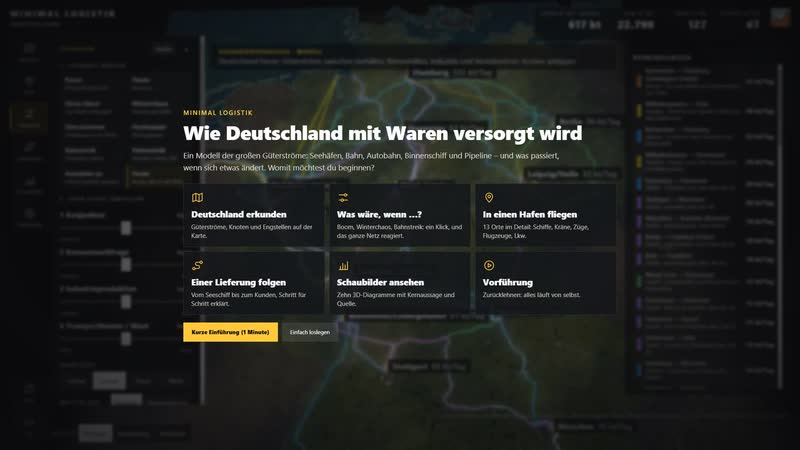
the start screen: where would you like to begin?
-
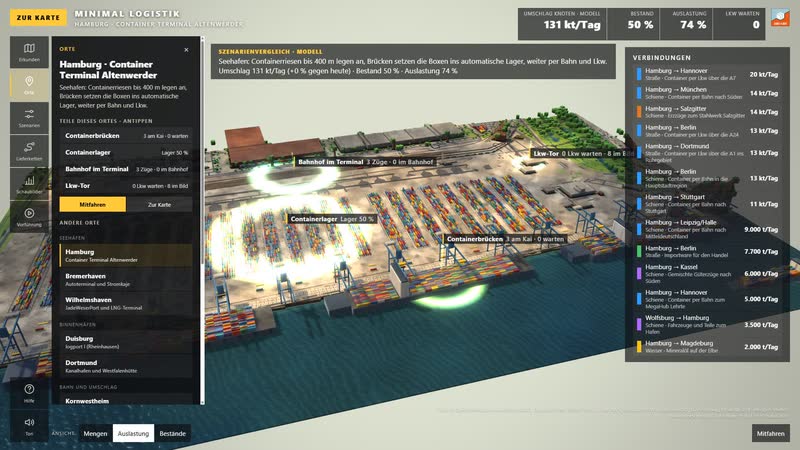
the profile of the Port of Hamburg with all parts and live values
-
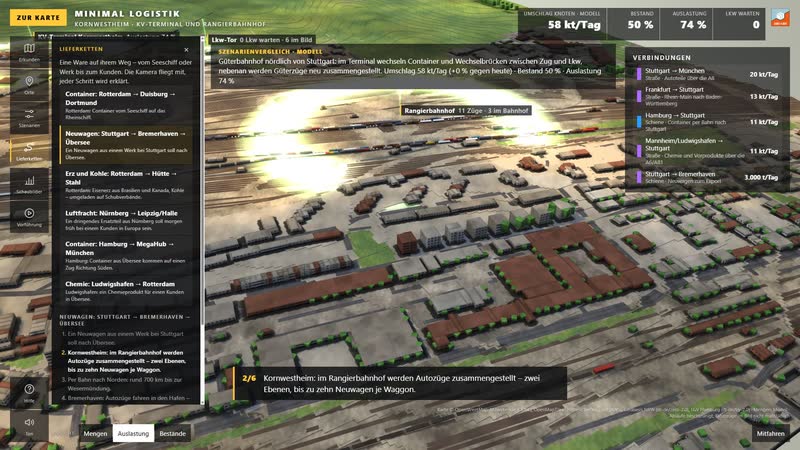
a supply chain with progress from source to destination
-
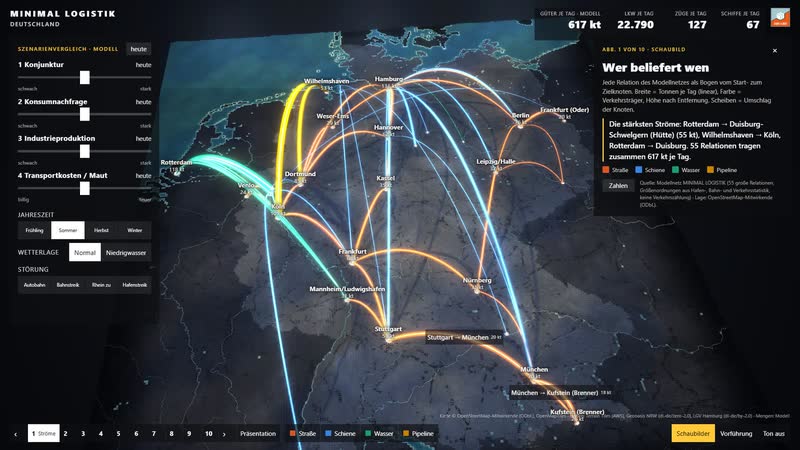
chart of flows: the freight flows as a 3D diagram in magazine style
-
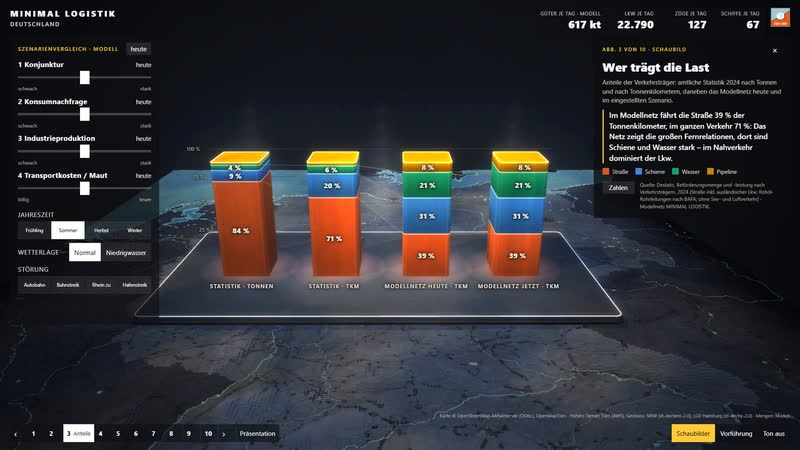
chart of shares: the modes of transport compared with official statistics
-
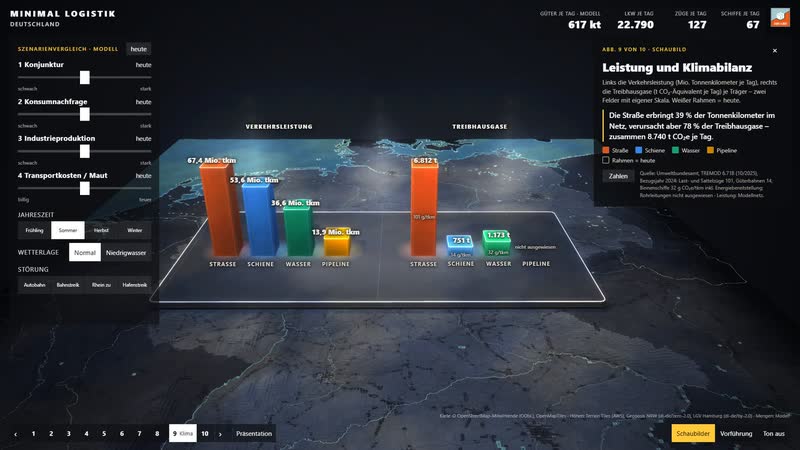
climate chart: the climate balance using German Environment Agency emission factors
-
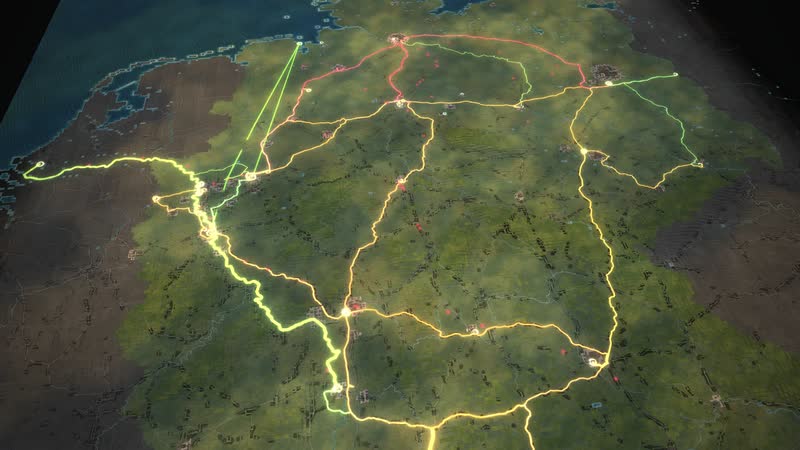
the map in winter, utilisation view: flows in traffic-light colours in snow and ice
-
the map during a rail strike: closed rail routes grey with red closure marks, freight shifts to the road
-
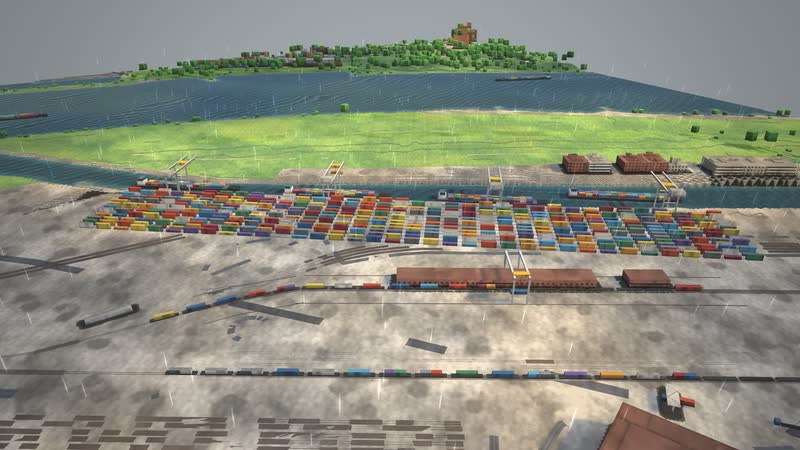
Duisburg in a flood: the Rhine closed, the water rising at the quays
-
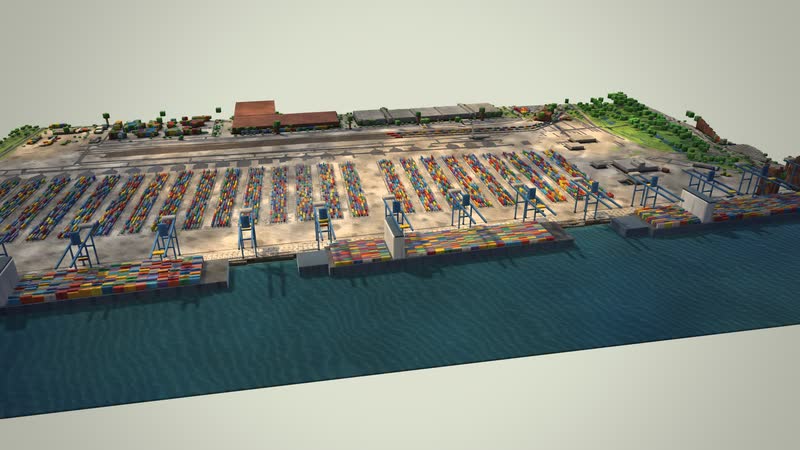
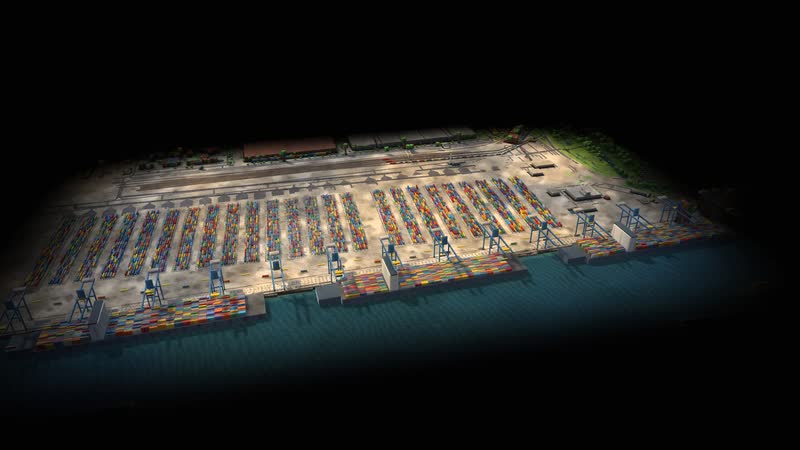
Container Terminal Altenwerder in Hamburg with container cranes, stacking blocks and rail link
-
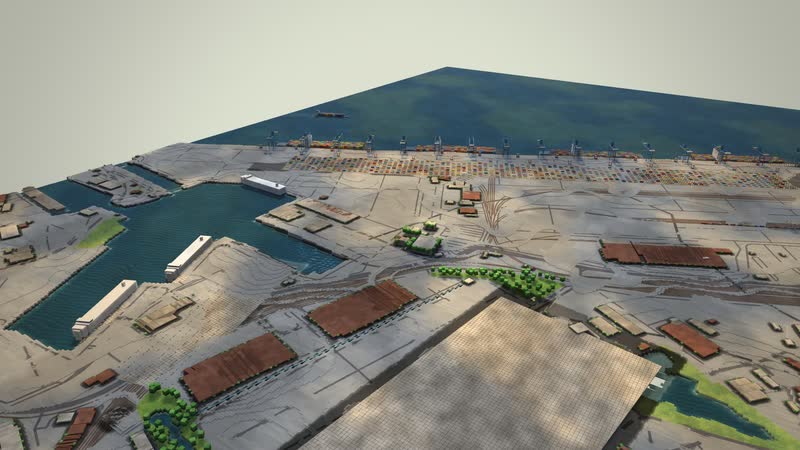
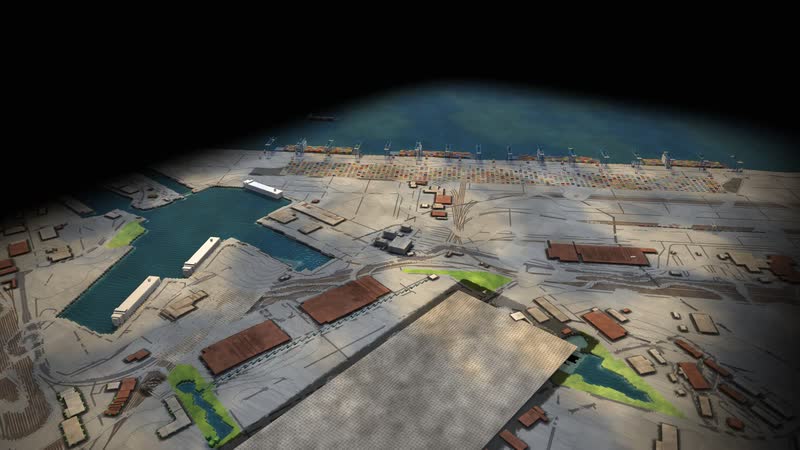
Bremerhaven, the river quay with container cranes on the Weser, behind it the car terminal and harbour basins with car carriers
-
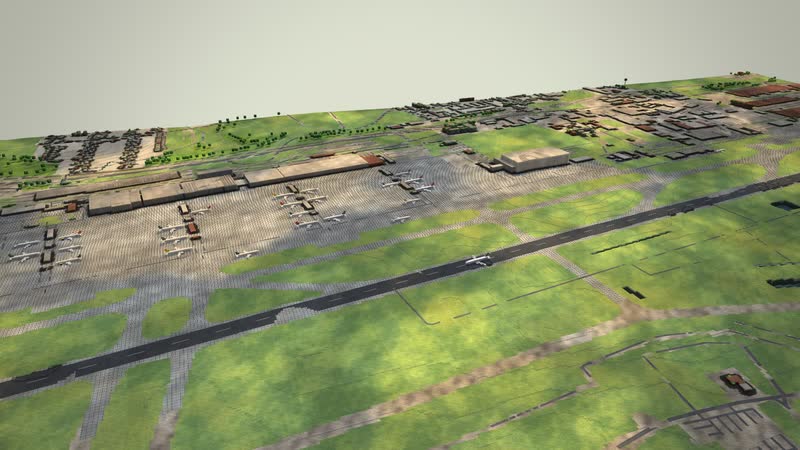
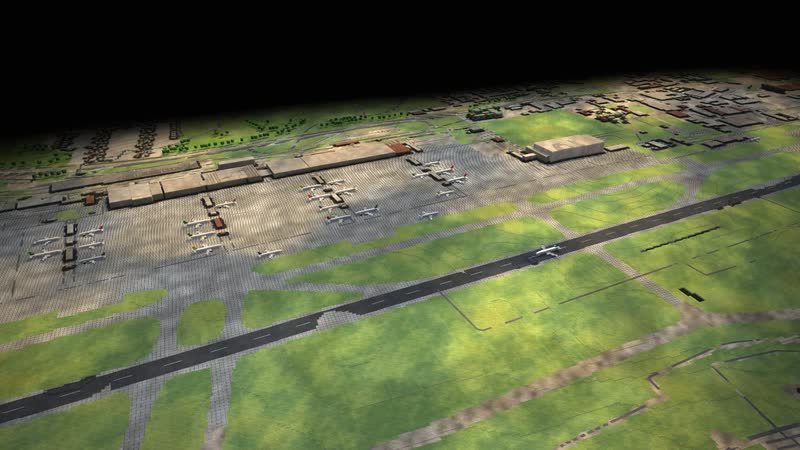
the Leipzig/Halle air cargo hub with freighters on the apron and one aircraft on the southern runway
Background
Maps and sites are based on open geodata: OpenStreetMap, Terrain Tiles, Geobasis NRW and LGV Hamburg.
Volumes are order-of-magnitude model assumptions, matched to Destatis and port figures – not traffic statistics per route. The page marks this at every figure.
Processes at the sites are accelerated and not to scale; a site’s throughput, stock and utilisation are the same figures as on the map.
Fourteen places
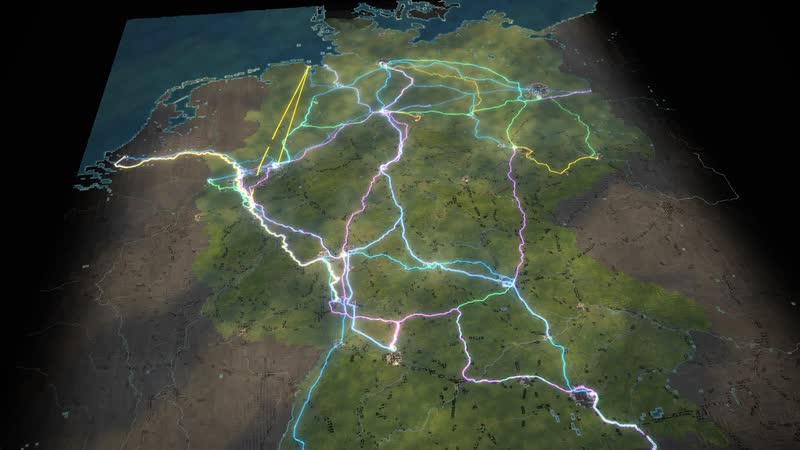
The relief map of Germany and thirteen detailed sites where the mechanics become visible.
Seaports
-
Hamburg · Container Terminal Altenwerder
An automated container terminal as a walkable model: up to 14 container gantries, driverless transport vehicles, the block yard, a rail station for trains up to 740 m and the truck gate.
-
Bremerhaven · car terminal and river quay
Bremerhaven as a walkable model: almost five kilometres of river quay for the largest container ships, straddle carriers, car trains and parking for about 95,000 vehicles at the mouth of the Weser.
-
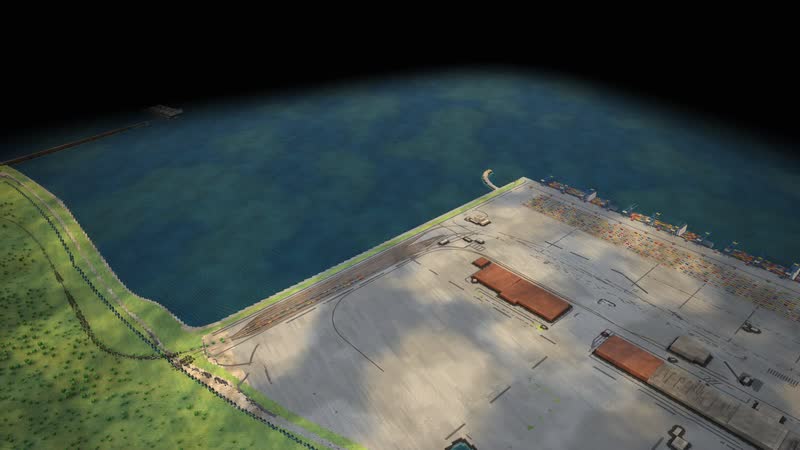
Wilhelmshaven · JadeWeserPort and LNG terminal
Germany’s only deep-water port as a walkable model: the container quay on the Jade with straddle carriers and rail, plus the floating LNG terminal, a tank farm and the crude-oil pipeline to the refineries.
Inland ports and industry
-
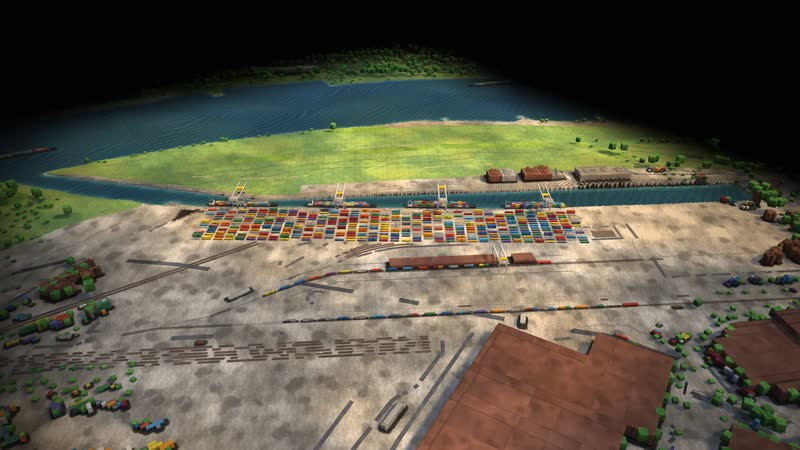
Duisburg · logport I (Rheinhausen)
A trimodal inland port on the Rhine as a walkable model: Rhine barges with sea containers from Rotterdam, gantries and yard, trains to the south, Eastern Europe and Asia, trucks into the region.
-
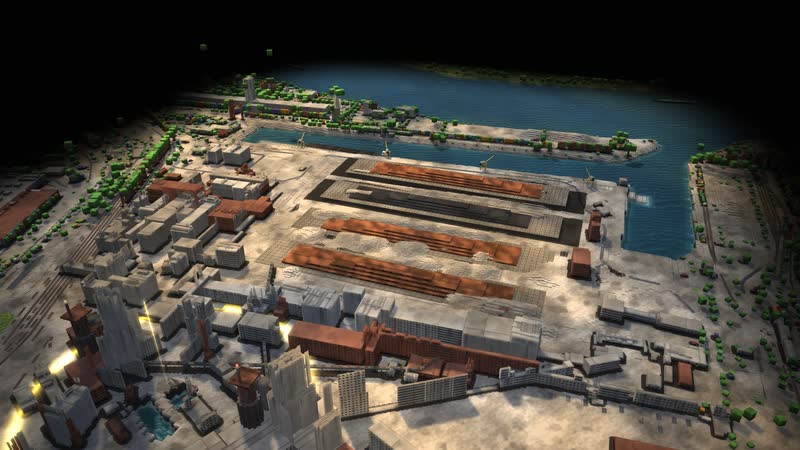
Duisburg-Schwelgern · works harbour and blast furnaces
A raw-material chain as a walkable model: push convoys with ore and coal from Rotterdam, grab unloaders, ore and coal stockyards, conveyor belts and the Schwelgern 1 and 2 blast furnaces.
-
Dortmund · canal port and Westfalenhütte
The canal port at the end of the Dortmund-Ems Canal as a walkable model: canal barges with two tiers of containers, three container gantries, four tracks and the route to the Westfalenhütte plant.
-
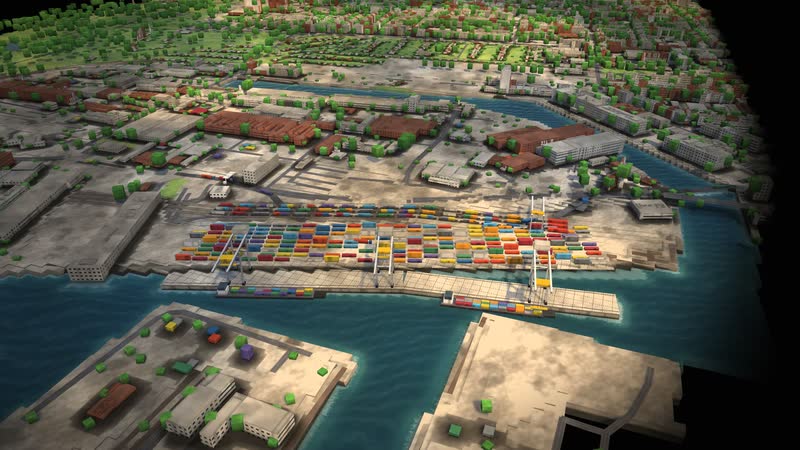
Ludwigshafen · chemicals on the Rhine
A large chemical site on the Upper Rhine as a walkable model: tankers at loading arms, tank wagons on the works railway, pipe bridges, the Friesenheimer Insel tank farm and the container quay.
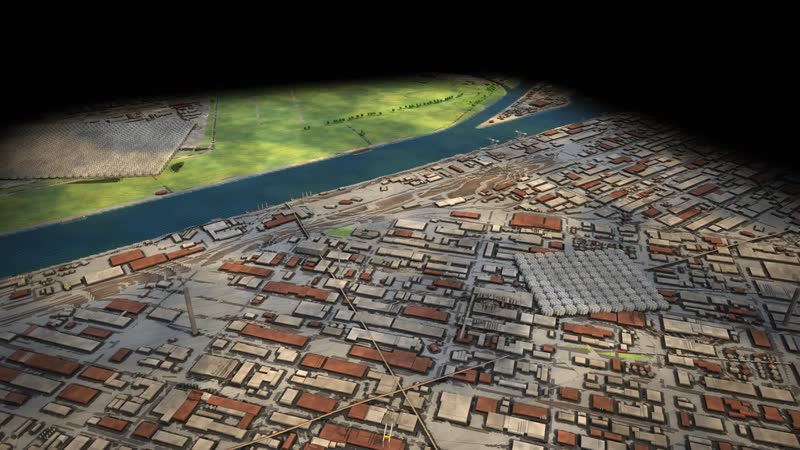
Road, air and distribution
-
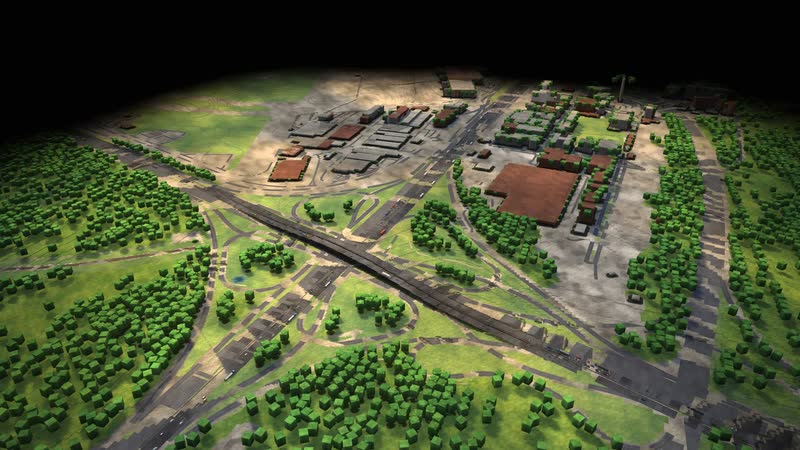
Frankfurt interchange (A3/A5)
One of Europe’s busiest motorway interchanges as a walkable model: the A3 and A5 cross, the weaving section becomes the bottleneck, and the tailback grows with freight, holidays or snow.
-
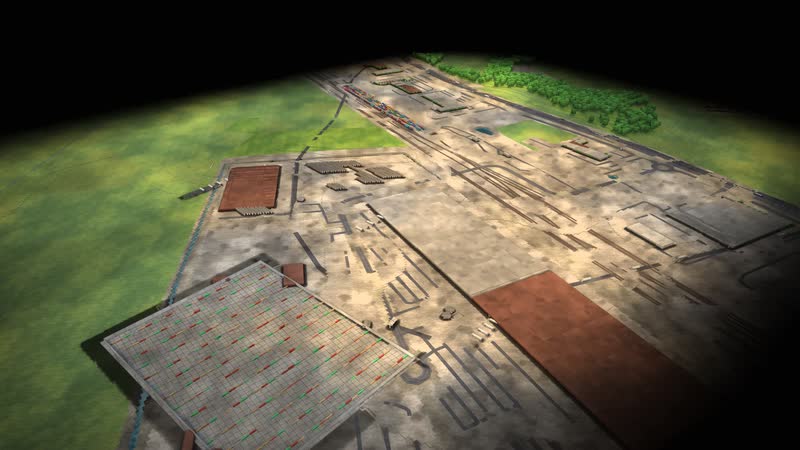
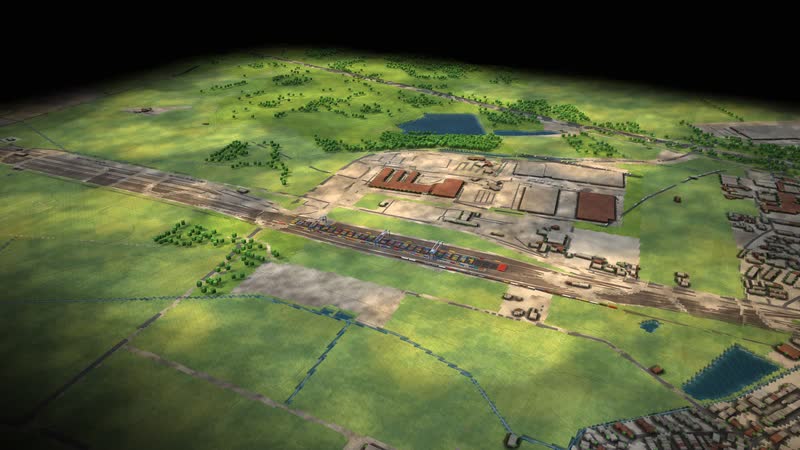
Großbeeren · freight village Berlin South
The freight village on the Berlin ring as a walkable model: distribution centres for retail and food, an intermodal terminal for goods from Hamburg, and the expressway the capital’s supply depends on.
-
Leipzig/Halle · air cargo hub
A night hub for air cargo as a walkable model: about 60 freighters a night on the 3,600-m south runway, the apron, the sorting halls and the A14 at the Schkeuditz interchange.
Rail and combined transport
-
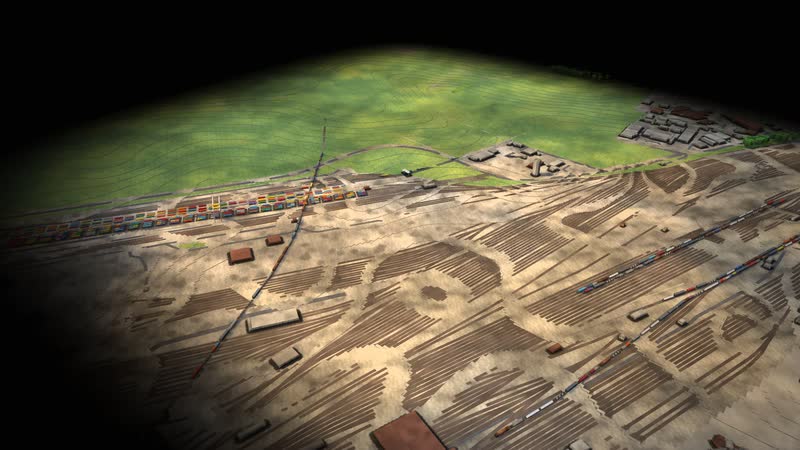
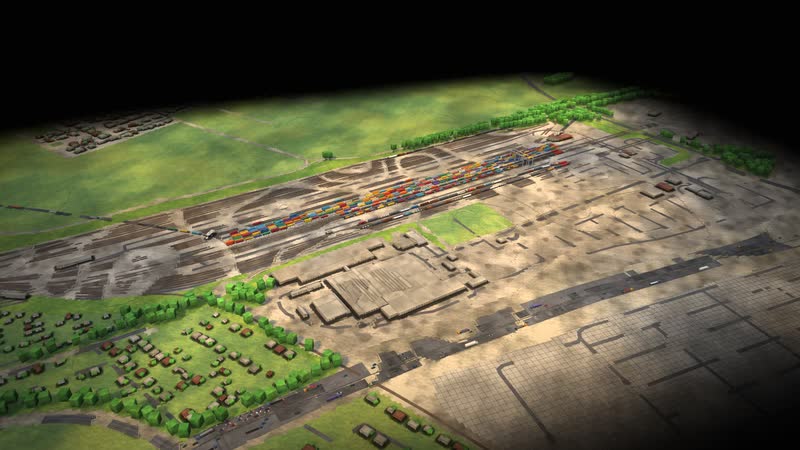
Kornwestheim · intermodal terminal and marshalling yard
A freight station and combined-transport terminal as a walkable model: gantry cranes between train and truck, a marshalling yard that re-forms freight trains, and car trains for export.
-
Munich · Riem transhipment station
The transhipment station in the east of Munich as a walkable model: container trains from Hamburg, Bremerhaven and Italy, gantry cranes between train, yard and truck, and the A94 next door.
-
Lehrte · MegaHub
A train-to-train transfer facility as a walkable model: six tracks of 720 m each, three gantry cranes, driverless transporters – and freight trains regrouped without shunting.
Controls
-
Desktop
Drag the mouse to pan, right button turns, wheel zooms. Keys: 1–4 sliders, ←/→, W winter, E weather, D display, L delivery, A demo, Esc back. Without input the demo starts after 75 seconds.
Minimal Logistik…
More +−
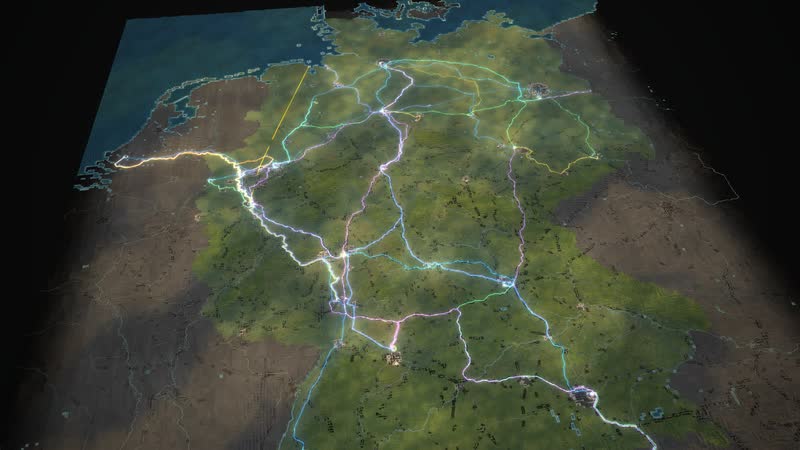
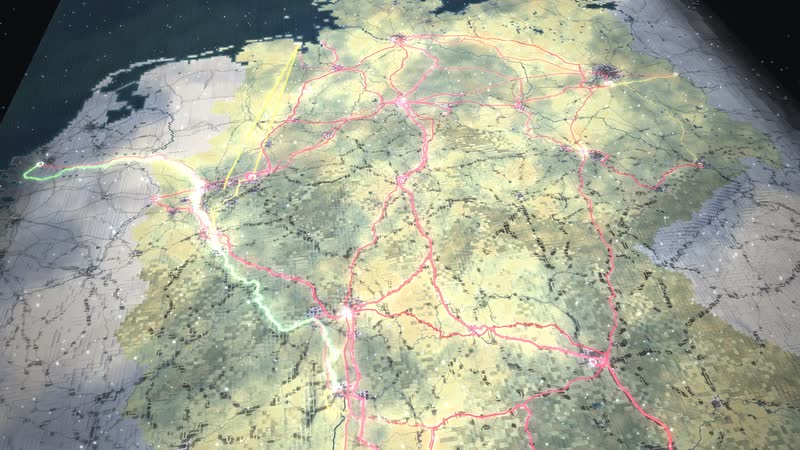
Minimal Logistics shows Germany’s main freight flows on a relief map: containers, raw materials, food, industrial goods and energy carriers on road, rail, water and pipeline.
Four big sliders – economy, consumer demand, industrial output, transport cost/tolls – instantly change flows, stocks, utilisation and jams. Everything is a scenario comparison with today.
Four seasons with extreme conditions – flood, low water, storm and fog, snow and ice – and four disruptions to trigger: motorway closure, rail strike, Rhine closure, port strike. You see at once where freight shifts and where stocks pile up.
Ride along: at a site the camera follows a ship, train, aircraft or truck, and a line tells you what it is doing.
Charts: ten 3D diagrams in magazine style. Flows, throughput, modal shares compared with official statistics, bottlenecks, the logistics year, the effect of every lever, the path from source to destination, the climate balance using German Environment Agency emission factors, and haul distances. Every chart calculates live with the sliders and names its source.
Clear guidance: a start screen asks where to begin. A menu leads to the map, sites, scenarios, supply chains, charts and demo. Ten scenario presets say what to watch. At every site a profile shows all parts with live values, and a short introduction explains the controls in one minute.
Thirteen detailed sites explain the mechanics: Port of Hamburg (CTA), Bremerhaven, Wilhelmshaven with the JadeWeserPort and LNG terminal, Duisburg logport I, Duisburg-Schwelgern, Dortmund canal port, Ludwigshafen with chemicals on the Rhine, Frankfurt interchange, Kornwestheim, Munich-Riem, Großbeeren, the Lehrte MegaHub and the Leipzig/Halle air cargo hub.
Six example deliveries: containers to Dortmund, ore to the blast furnace, new cars via Bremerhaven, air cargo via Leipzig/Halle, containers from train to train at the Lehrte MegaHub and a chemical product by tanker to Rotterdam.
How to play
More +−
- Four sliders: economy, consumer demand, industrial output, transport cost/tolls. Plus summer/winter and extreme weather such as low water and snow.
- Every change is a scenario comparison with today: flows, stocks, utilisation and jams change instantly.
- A detailed site shows throughput, stock and utilisation with the same figures as the map.
- Six example deliveries can be followed; the L key switches between them.
Minimal Logistik
How Germany’s supply of goods fits together – freight flows, ports, rail and jams.
cube4tec.de/spiele/minimal-logistik/