
Simulation · A game by CUBE4ARTS
Minimal Water
Rain, heat, consumption: three big levers, and the landscape shows the consequences – fields bloom or wither, rivers rise or run dry, homes lose their water, forests die. Five values from Living to Harvest, five regions on real terrain. Free in your browser.
- Free
- No installation
- No sign-up
- Desktop · Phone · Tablet
Minimal Water
“Start” opens the water cycle: at the bottom three big levers – Rain, Heat, Consumption – and four weather presets that set them with one tap. The landscape shows what they do: in good times the houses are bright, fields bloom, flocks of birds cross the forest. In a drought fields wither, trees die, the river turns narrow and warm, dead fish drift, the reservoir dries out from the shore; dry forest can catch fire. When the town runs short of water, whole neighbourhoods fade, houses stand empty and decay. Lots of rain brings floods and overflowing sewers. At the top sit water in town, storage and five values, and signs on the map mark where things happen; tap to fly there. On the right a small wheel, at the bottom a subtitle explaining what is happening. Trees of trunk and crown sway in the wind; dead ones leave grey trunks, burnt ones black, and fields have rows. With rain the land recovers, a dead forest does not. For specialists the “Control room – for experts” remains.
Terrain, buildings, roads, railways, rivers and treatment plants from OpenStreetMap and an elevation model, built from tiles; pipe network, sizes, demand and the reservoir operation are invented, supply lines and sewers generated from the street network. The cycle and its consequences are simplified for teaching – no water-balance calculation. Minimal Water is a playable preview for museums, waterworks and municipal utilities, a simplified educational model – not a real control system and not a planning tool. Under “Use cases” the game sketches what it can become: a web application, an interactive table or a large projection with real valves, hand wheels and levers. Made for schools too – and for anyone who wants to know why water comes out of the tap and what drought and heat do. The game is available in German and English; in other languages it appears in English. It runs right in your browser: no download, no app, no sign-up.
Trailer
Plays everywhere
-
Desktop
Click a weather preset or press 4–7; drag the three levers sideways, or pick one with 1–3 and set it with ←/→. Drag moves the map, right button rotates, wheel zooms; WASD, Q/E, +/−, Home overview, Space pauses, Esc menu. In the control room for experts: 1–5 pick a control.
-
Phone & tablet
At the bottom weather presets and three levers – drag sideways with a finger –, above them the subtitle. At the top water in town, storage and five values, below them the wheel; tap values, signs and stations and the camera flies there. One finger moves the map, two rotate, pinch zooms. No app.
5 regions
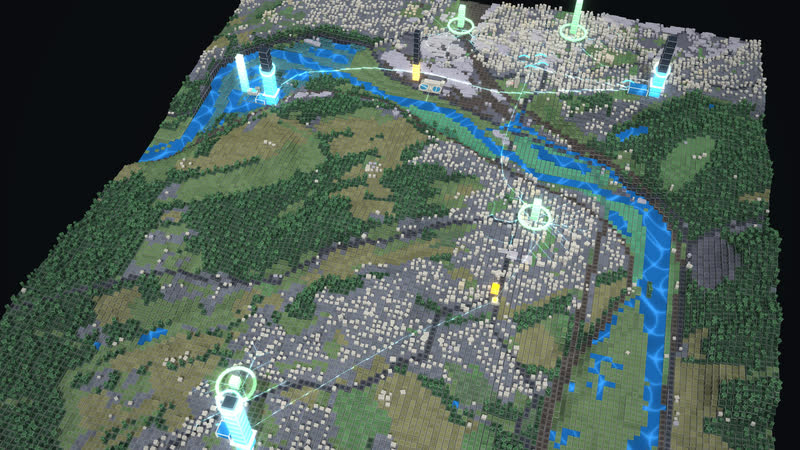
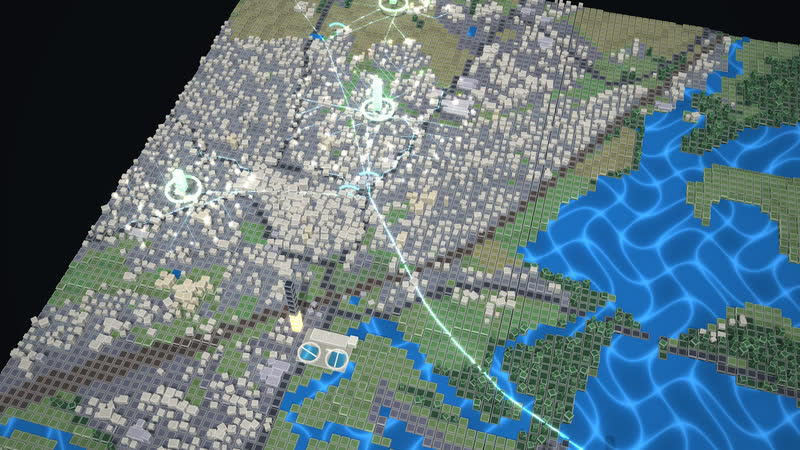
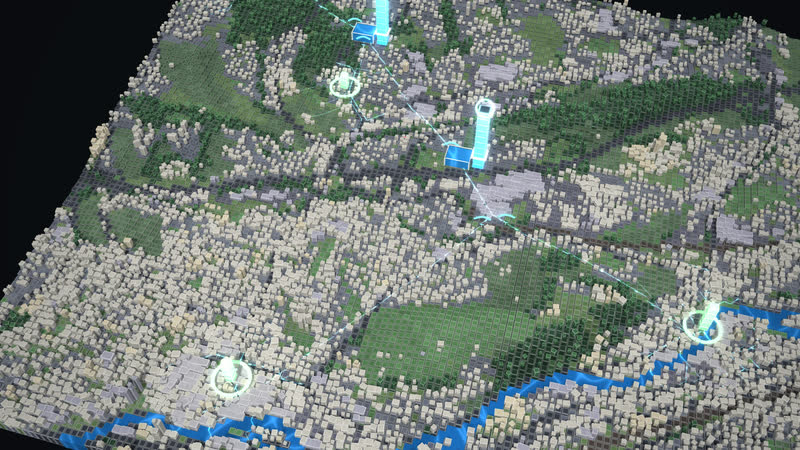
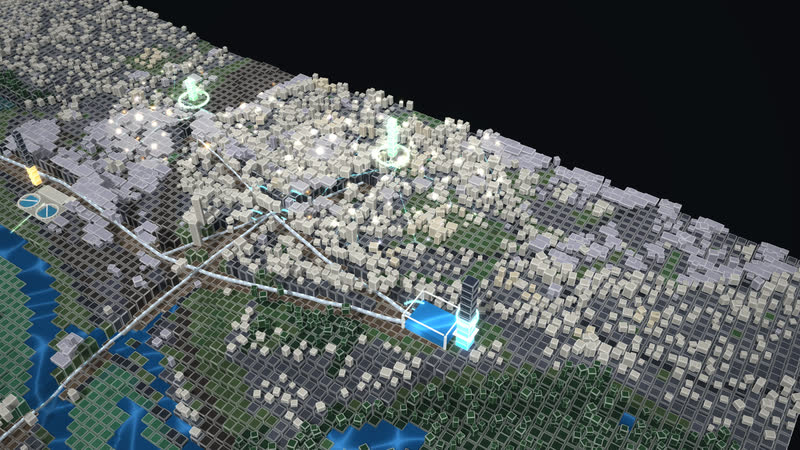
Witten: Ruhr valley with waterworks and water tower. Haltern: reservoir lake, wells in Hohe Mark and Haard. Wuppertal: pressure zones stacked. Plus two regions with a reservoir dam: Siegburg · Wahnbach valley with a ring main and Arnsberg-Neheim · Möhne lake, whose lake also tops up the Ruhr.
-
01 Witten · Ruhr valley
-
02 Haltern am See
-
03 Wuppertal
How to play
- “Start” on the title screen – or “Let’s go” after the “Introduction” – opens the “Water cycle”, first in Witten; switch region under “Regions”. At the top “Water in town”, “Storage” and the five values, the wheel on the right, at the bottom subtitle, weather presets and levers. Clock, figures and control room are hidden here.
- One tap on one of the four weather presets – “Normal year”, “Hot summer”, “Drought”, “Heavy rain”, on a computer 4–7 – moves all three levers there, visibly, then the camera flies to where the effect shows; for finer settings drag the horizontal levers sideways. Where things turn critical, a sign appears on the map – “Forest fire”, “Crop failure”, “No water”, “Fish dying”, “Reservoir empty”; tap it to fly there and read about it.
- Rain goes from “drought” through “dry”, “normal” and “wet” to “storm”, Heat from “normal” through +1, +2 and +3 °C to “heatwave”, Consumption from “frugal” through “normal” to “wasteful”. Each lever shows its level as a word; on a computer 1–3 pick a lever and ←/→ or ↑/↓ move it by an eighth.
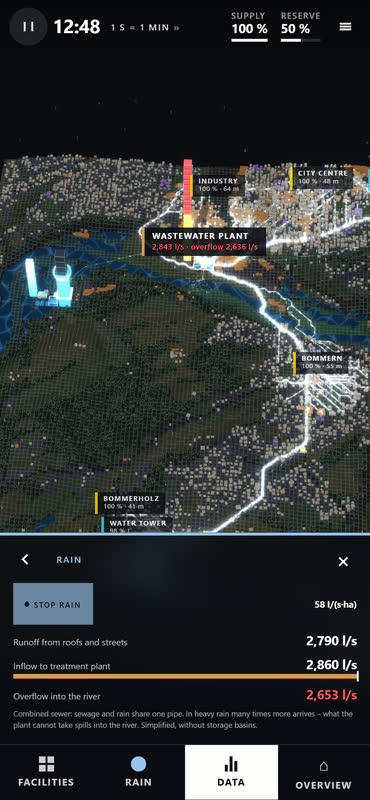
- The landscape is the display: in a drought meadows turn straw-yellow, fields dusty brown and in the extreme cracked, trees die in patches, leaving grey trunks, the river turns narrow and warm, the reservoir dries out from the shore. In good times fields bloom, flocks of birds fly, people show as points of light in the streets. Lots of rain brings floods, the sewers overflow and untreated water flows into the river.
- At the top five values, each with one word: Living (“good”, “limited”, “poor”, “uninhabitable”), Health (“good” to “emergency”), Safety (“safe”, “danger”, “emergency”, “disaster”), Nature (“thriving”, “suffering”, “dying”, “dead”), Harvest (“rich”, “meagre”, “crop failure”, “none”). Tap one and the camera flies to where it can be seen while the subtitle explains it, for example: “Harvest: fields need rain at the right time. Drought means crop failure – food becomes scarce and expensive.”
- When the town runs short of water, single neighbourhoods turn from bright to beige, ochre and dark, and the houses collapse. At the top “Storage” with an arrow shows how long the tanks still supply the town – using less makes them last longer. In drought and great heat the forest can burn, blue lights are on their way, and fish die in the warm, shallow river.
- Rain all the way down and heat all the way up lead, in Witten after about a minute, to the extreme: no birds, no people, and in large letters “Life is no longer possible here”. “Wasteful” speeds up the shortage, “frugal” delays it. With rain, soil, river, fields and houses come back quickly; dead and burnt forest takes much longer, and the subtitle says so.
- The cycle runs by itself – showers with clouds and shadows, haze in the heat, water particles along the rivers; the water works draw on wells, river and reservoir and run themselves, and there are no random pipe bursts here. The wheel shows eight stations – Rain, Soil, Groundwater, River, Reservoir · lake, Water works, Water in town, Treatment plant – with a fill ring and colour, linked by flowing arcs; tap a station to fly there and read what it does, for example: “Rain falls on the land.”
- At the bottom a subtitle with a topic explains what is happening – first the extreme, then flood, forest fire, shortage, health, storage, fish, trees, harvest; when all is calm it leads station by station through the cycle. The camera follows: after a lever, to where the effect shows. After 90 seconds without input the weather runs by itself – “Self-running · touch the screen to take control”.
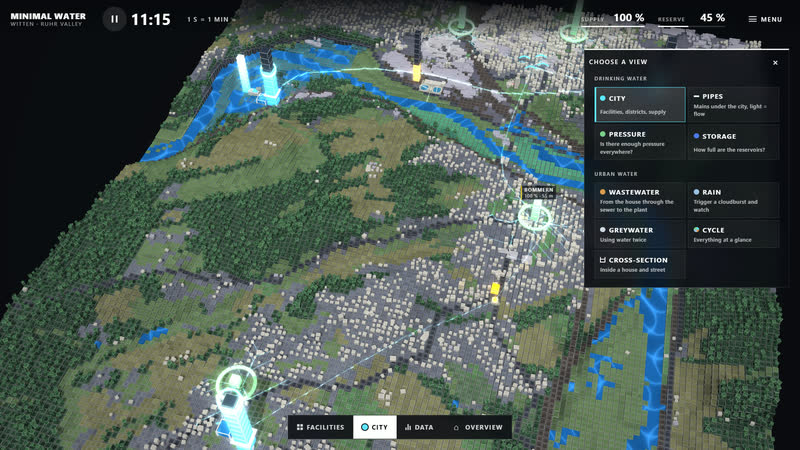
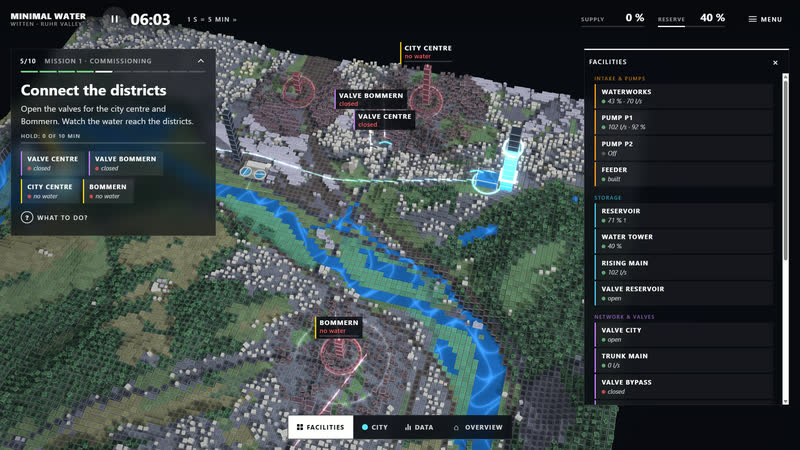
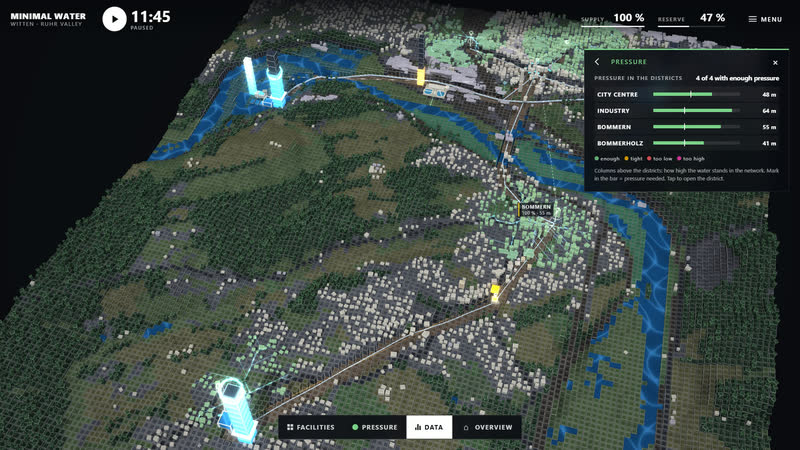
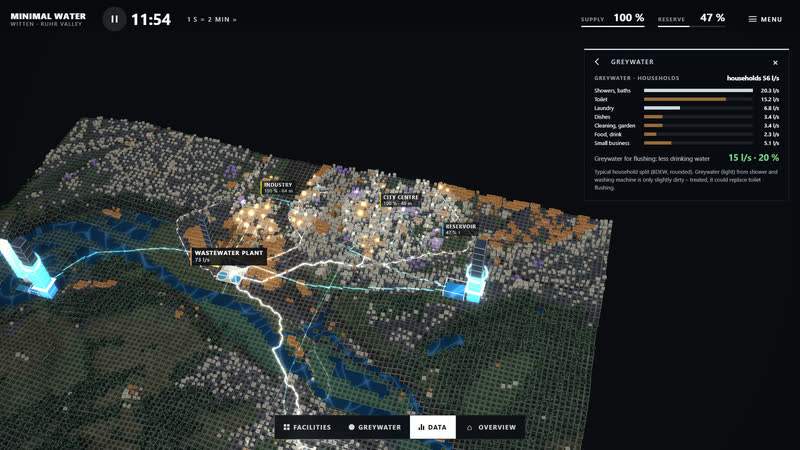
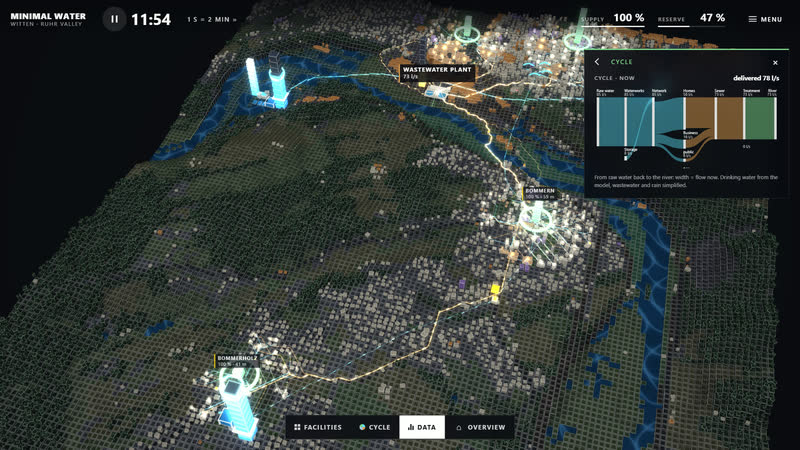
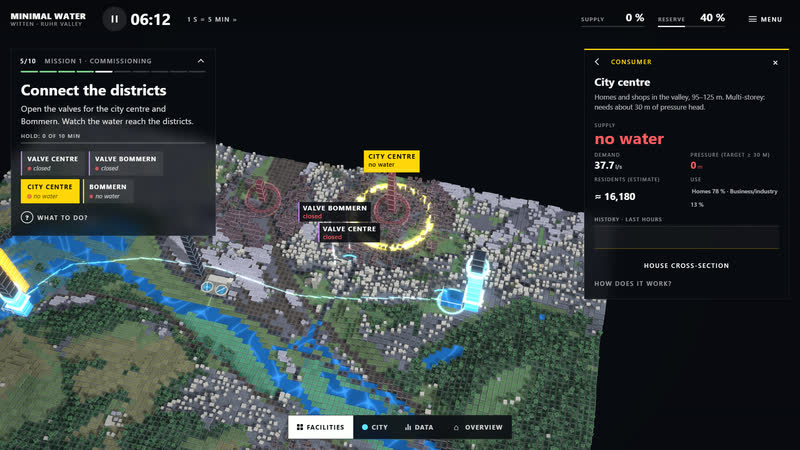
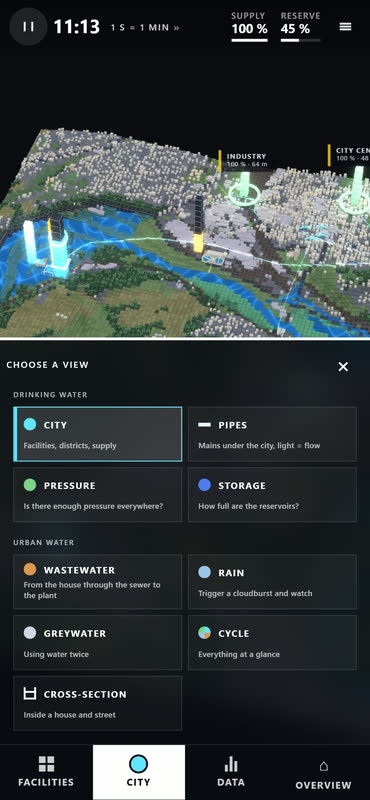
- “Control room – for experts” opens the technical operation: five controls – Supply rate, Storage target, Network pressure, Repair crews, Treatment plant – with stations on the map, a 24-hour forecast, water bands, “What if …” with Heatwave, Cloudburst, pipe burst and, in Siegburg and Arnsberg-Neheim, “Drought”, call-outs, and the bar with “Facilities”, view, “Data”, “Overview” and nine views down to the cross-section through house and street. The 3D charts start switched off (Settings). For museum use there is a Demo.
Minimal Water
Rain, heat, consumption: three big levers, and the landscape shows the consequences – fields bloom or wither, rivers rise or run dry, homes lose their water, forests die. Five values from Living to Harvest, five regions on real terrain. Free in your browser.
cube4tec.de/spiele/minimal-water/