
Simulation · Minimal Organization · Money and insurance
Bank
A bank as a walkable model: a business loan from first vote to disbursement, with sales and risk kept apart up to the board, in a running simulation.
Trailer
All data are fictional – RHEINBOGEN BANK does not exist. The model can be fitted to your bank's real data and filled with what is visible nowhere today: lead times by loan type and authority level, or applications per analyst and committee date.
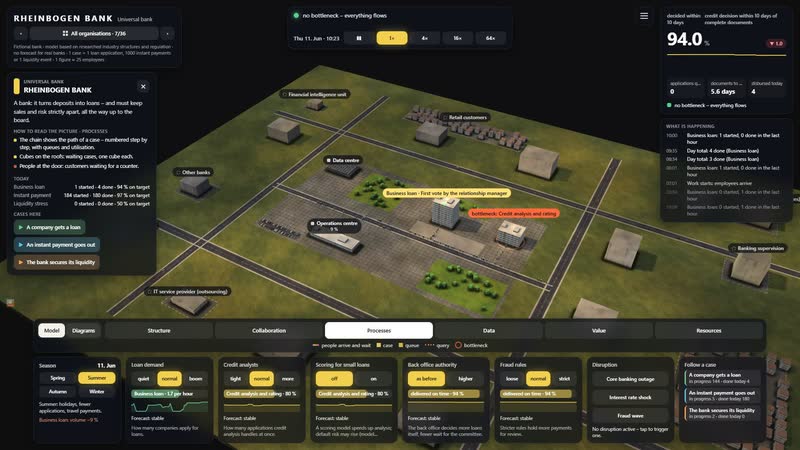
The business loan approval process at a bank, as a running model. At the fictional RHEINBOGEN BANK, sales and risk are kept apart all the way up to the board – on the site they even sit in two separate buildings, the tower and the risk house. The main process shows a business loan with a first vote, rating, collateral valuation, anti-money-laundering check and a decision by the back office. Above its authority limit, the loan goes to the credit committee, which meets only on Tuesdays.
The site also includes an operations centre and a data centre. Alongside the loan, an instant payment goes out within seconds after a fraud check, and the bank secures its liquidity in a stress scenario. An interest rate shock forces every open application to be recalculated for ten days.
The authority limit and the effect of scoring are model assumptions. Documented in the sources: the separation of sales and risk, the second vote and the three lines of defence. This page is for the board, credit management, corporate banking, organisational development, training and internal audit.
A company gets a loan
- 01
First vote by the relationship manager: The relationship manager reviews the application and gives the first vote.
- 02
Analysis, collateral and AML check run at the same time.
- 03
Credit analysis and rating: Credit analysis works through accounts and plans and assigns a rating: the second vote.
- 04
Value collateral: Land, machines, receivables: what is the collateral worth?
- 05
Anti-money laundering and customer check: Who really owns the company? Is anyone on a sanctions list?
- 06
Both votes and all checks are in.
- 07
Determine authority level: Depending on the amount, the back office decides itself or the credit committee does.
- 08
Decision in the back office: The back office decides within its authority.
- 09
Credit committee (Tuesdays): The credit committee meets on Tuesdays.
- 10
Company provides more: Approved with conditions: the company must provide more.
- 11
Again: Credit analysis and rating: Analysis checks the additional documents.
- 12
Declined.
- 13
Contract and collateral: Loan processing drafts the contract and arranges collateral.
- 14
Notary and land registry: Notary and land registry register the land charge.
- 15
Disbursement: The money goes to the company account.
- 16
Disbursed.

01
A site at work
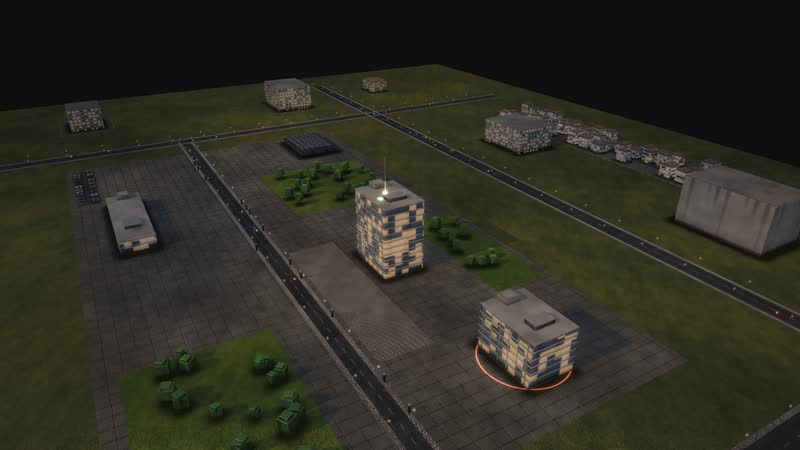
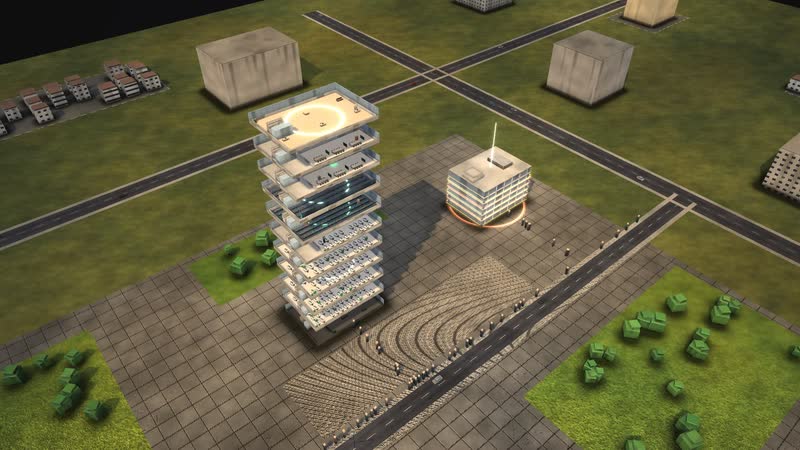
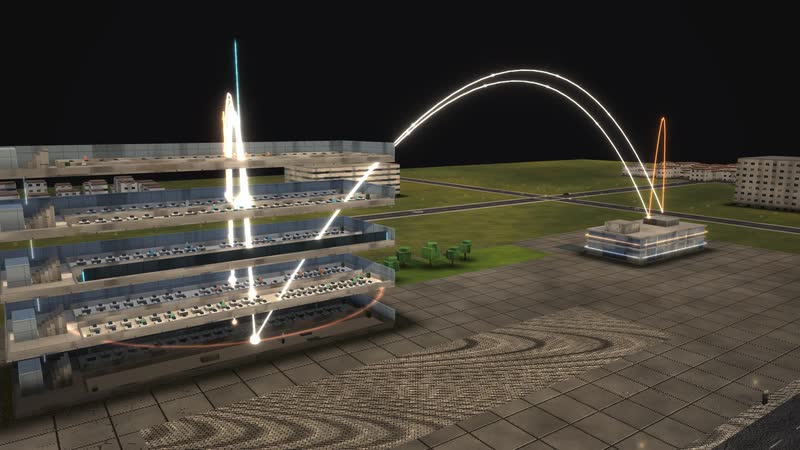
4 buildings, 18 departments, about 3,500 staff: in the evening light golden arcs show who reports to whom.

02
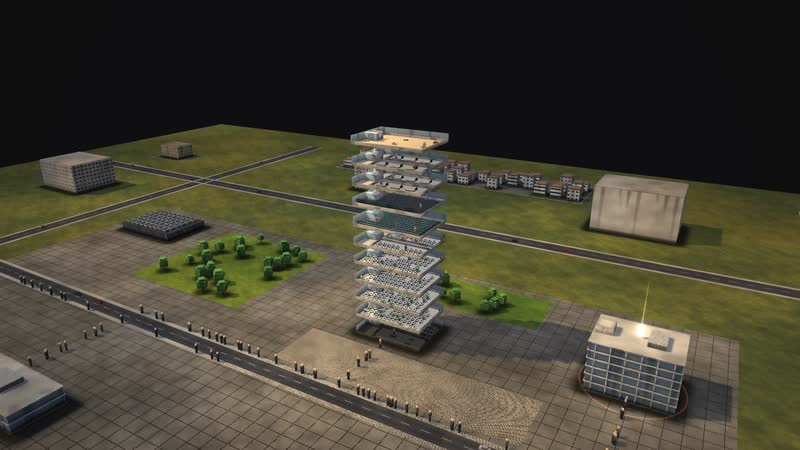
Every floor opened up
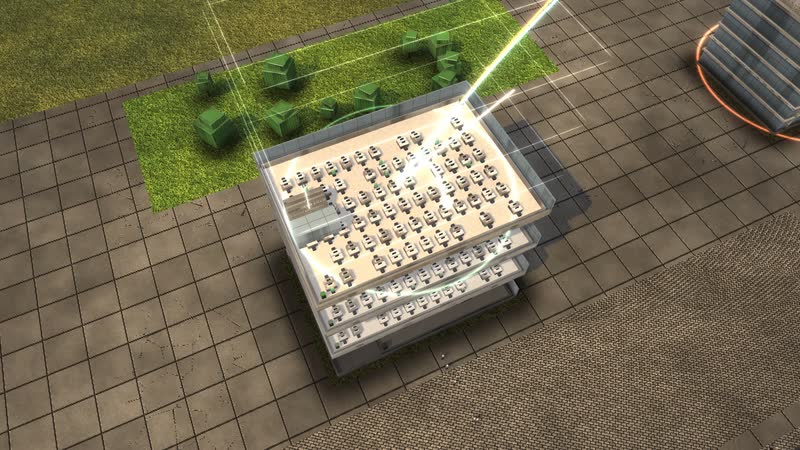
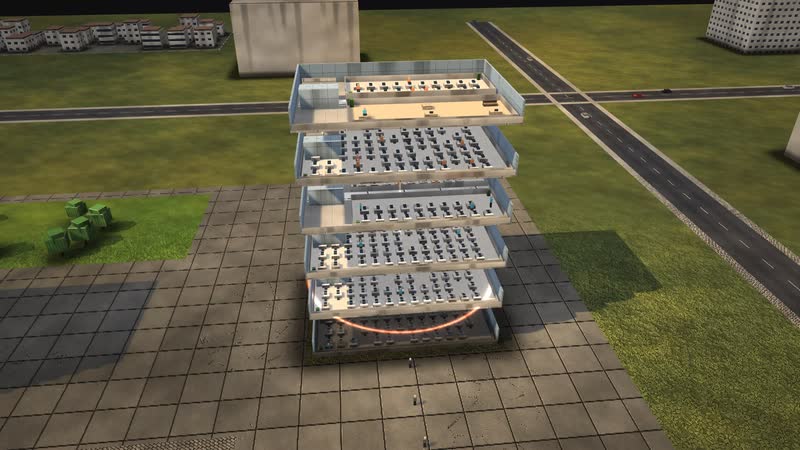
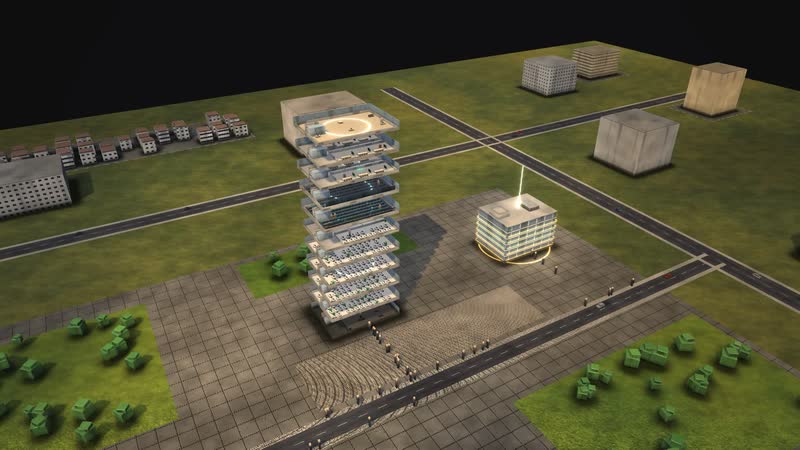
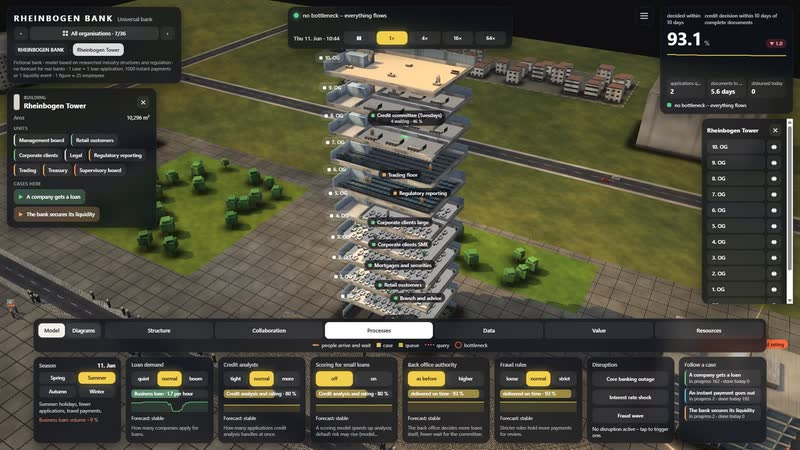
Every building can be opened, floor by floor – right into single rooms such as ‘Management board’, with workplaces and people at work.
What is shown – why – for whom
| What is shown | Why | For whom |
|---|---|---|
| Diagram ‘Who leads whom’: sales and risk up to the board | WhyMakes visible the separation the supervisor requires. | For whomBoard, internal audit, supervisors |
| Diagram ‘Management levels as a staircase’ | WhyShows the levels between relationship manager and board. | For whomOrganisational development |
| Diagram ‘Where the time goes’: rating, collateral, committee | WhyShows where the ten days get stuck. | For whomCorporate banking, credit management |
| Diagram ‘Year, week, day’: credit committee on Tuesdays | WhyExplains why one day's delay can cost a week. | For whomRelationship managers, customers |
| Diagram ‘What each control does’: authority, scoring, analysts | WhyWeighs speed against risk. | For whomBoard, risk control |
| Collaboration view between the tower and the risk house | WhyShows the handovers of a loan. | For whomOnboarding, training |
| Process ‘An instant payment goes out’ with the control ‘Fraud rules’ | WhyShows processes in seconds next to processes in days. | For whomPayments, fraud prevention |

03
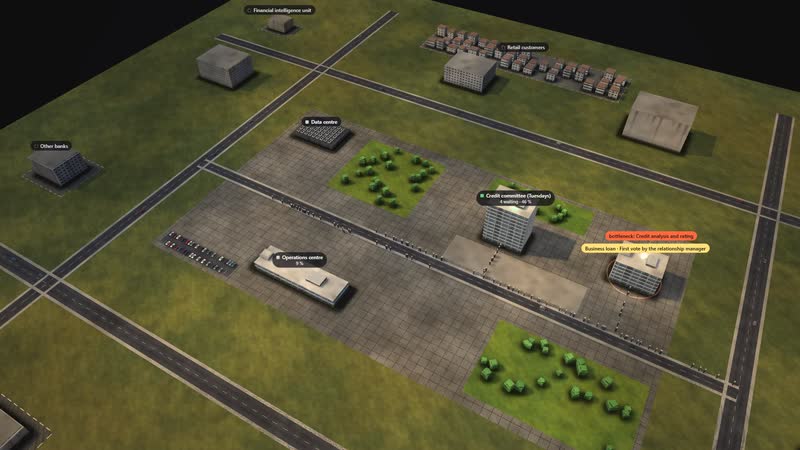
Who works with whom
‘Corporate clients’ with all 4 relations: Credit analysis, Loan processing and Internal audit – and outside Corporate clients (SMEs).
04
A company gets a loan
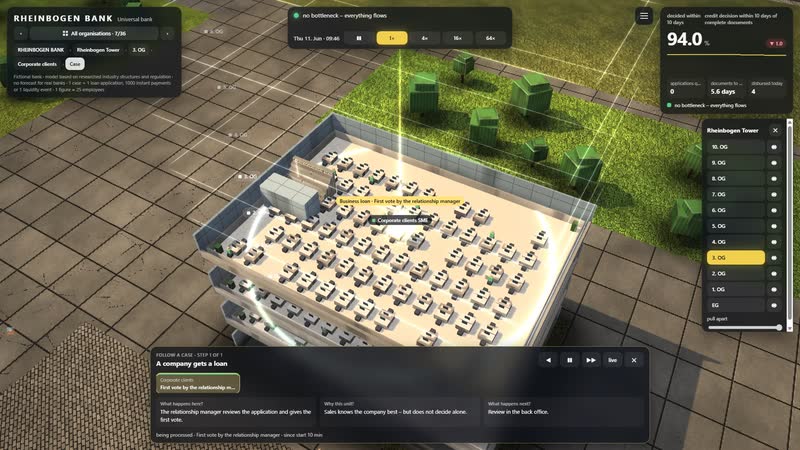
A single case can be followed – step by step, with the waiting time at every station. Target: credit decision within 10 days of complete documents.
Films from the model
-
The tower opens up
Just before sunset the floors drift apart – ‘Rheinbogen Tower’ opens up as the camera rises and circles the building until night falls.
-
Who reports to whom, who works with whom
Blue hour above the site: first the golden arcs of the structure, then the collaboration of the most connected department, finally the whole building.
-
A day in time-lapse
From ten in the morning to midnight in 26 seconds: the sun moves, the windows light up, at night the data lines glow.
-
Surge and system outage
In time-lapse: ‘Interest rate shock’ brings more work, then ‘Core banking outage’ – the data arcs turn red. The control ‘Credit analysts’ set to ‘more’ brings recovery.
-
Seven diagrams
Calculated live from the model: ‘Who works with whom’, ‘Year, week, day’, ‘Management levels as a staircase’, ‘How a case flows’, ‘What each control does’, ‘What the work depends on’, ‘Where it gets tight’.
-
Using the software
With the full interface: open a building, a department’s relations, ‘Interest rate shock’, a control, diagrams with their panel, one case.
Departments in the model
-
Management board
Runs the bank; responsible for risk management.
-
Supervisory board
Oversees the management board, with risk and audit committees.
-
Chief risk officer (back office)
A separate board portfolio: front office and back office are separated up to the board.
-
Retail customers
Accounts, cards, mortgages and advice in branches and online.
-
Corporate clients
Serves companies and gives the first vote on loans.
-
Credit analysis
Assesses creditworthiness and rating independently of sales and gives the second vote.
-
Loan processing
Values collateral, drafts contracts, monitors running loans.
-
Workout
Takes over loans that get into trouble.
-
Risk control
Measures the risks of the whole bank: second line of defence.
-
Compliance and AML
Customer checks (KYC), sanctions, suspicious transaction reports; the money laundering officer sits here.
-
Internal audit
Audits all areas independently: third line of defence.
-
Treasury
Manages liquidity and interest rate risk; arranges funding.
-
Trading
Trades securities, rates and currencies for clients and the bank.
-
Payments
Books and forwards transfers, direct debits and card payments.
-
Fraud prevention
Checks suspicious payments within seconds – by hand when in doubt.
-
IT
Core banking, data centre, security; outsourcing is managed, not handed off.
-
Regulatory reporting
Reports capital and liquidity to the supervisor.
-
Legal
Contracts, collateral, disputes.

05
Core banking outage
The data arcs turn red and work stalls – the simulation shows where cases pile up and how long recovery takes.
06
A day in 26 seconds
From ten in the morning to midnight in time-lapse: commuters, moving light, windows switching on – and at night the data lines.
All processes in the model
A company gets a loan
- 01First vote by the relationship manager: The relationship manager reviews the application and gives the first vote.
- 02Analysis, collateral and AML check run at the same time.
- 03Credit analysis and rating: Credit analysis works through accounts and plans and assigns a rating: the second vote.
- 04Value collateral: Land, machines, receivables: what is the collateral worth?
- 05Anti-money laundering and customer check: Who really owns the company? Is anyone on a sanctions list?
- 06Both votes and all checks are in.
- 07Determine authority level: Depending on the amount, the back office decides itself or the credit committee does.
- 08Decision in the back office: The back office decides within its authority.
- 09Credit committee (Tuesdays): The credit committee meets on Tuesdays.
- 10Company provides more: Approved with conditions: the company must provide more.
- 11Again: Credit analysis and rating: Analysis checks the additional documents.
- 12Declined.
- 13Contract and collateral: Loan processing drafts the contract and arranges collateral.
- 14Notary and land registry: Notary and land registry register the land charge.
- 15Disbursement: The money goes to the company account.
- 16Disbursed.
An instant payment goes out
- 01Order in online banking: Someone authorises an instant payment in online banking – with strong authentication.
- 02Verification of payee: Does the name match the account? The payee's bank answers instantly.
- 03Fraud and sanctions screening: A machine checks patterns and sanctions lists in milliseconds.
- 04Manual review: A person looks at the payment and calls if needed.
- 05Prepare suspicious transaction report: Suspicion of money laundering or fraud: compliance prepares a report.
- 06Report to the intelligence unit: The report goes to the intelligence unit.
- 07Payment stopped.
- 08Book and forward: The core banking system books and forwards.
- 09Clearing via TIPS: The central bank clearing settles between banks.
- 10Credit at the payee's bank: The payee's bank credits the account.
- 11Arrived.
The bank secures its liquidity
- 01Early warning: outflows: Treasury sees unusual outflows – customers withdraw money.
- 02Crisis team: The crisis team activates the contingency plan.
- 03Collateral to the central bank, communication, report to the supervisor – at the same time.
- 04Collateral at the central bank: Securities go to the central bank as collateral, liquidity comes back.
- 05Communication to clients and market: Customers and market are informed.
- 06Liquidity report to the supervisor: Reporting informs the supervisor.
- 07All measures are running.
- 08Review: are the outflows covered?: Treasury checks: are the outflows covered?
- 09Sell securities: Trading sells securities.
- 10Review and contingency plan: Risk control evaluates and adjusts the contingency plan.
- 11Supervisor assesses: The supervisor assesses the situation and the review.
- 12Stable.
How a bank can use the model
-
Internal communication
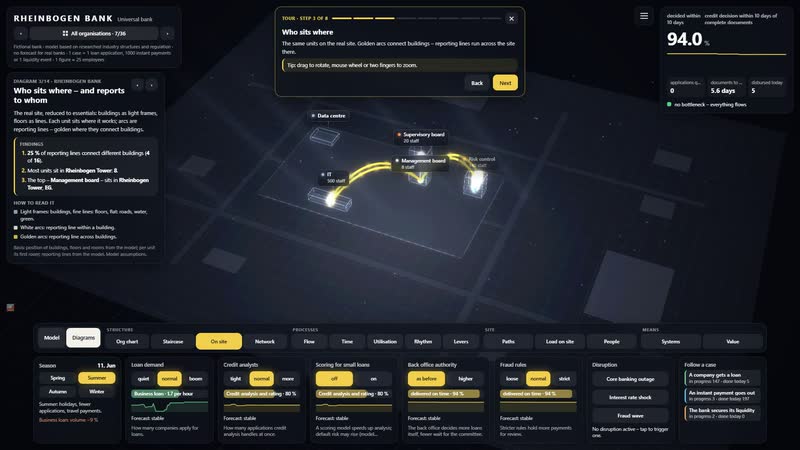
The diagram ‘Who leads whom’ shows sales and risk as two pillars that only meet at board level. ‘Management levels as a staircase’ shows how many levels lie between relationship manager and board.
For whomBoard, organisational development, internal comms
-
Onboarding
New colleagues see the handovers of a loan between the tower and the risk house in the collaboration view – from first vote to disbursement.
For whomNew staff in corporate banking, credit analysis and loan processing
-
Training
Trainees play through the fraud wave: for one day every manual review takes three times as long. The ‘Fraud rules’ control shows how stricter rules hold more payments for review.
For whomApprentices, graduate trainees, payments
-
Explaining to customers
Business customers see why one day's delay can cost a week: above the authority limit, the loan waits for the next Tuesday. ‘Year, week, day’ shows the weekly rhythm.
For whomRelationship managers, business customers
-
Strategic overview
Higher back-office authority, scoring for small loans, more analysts: ‘What each control does’ weighs speed against risk before the authority rules are changed.
For whomBoard, risk control, credit management

07
Diagrams from the model
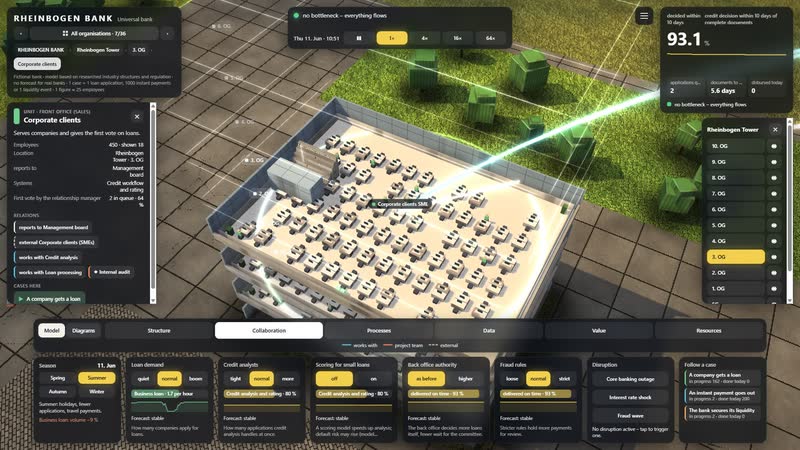
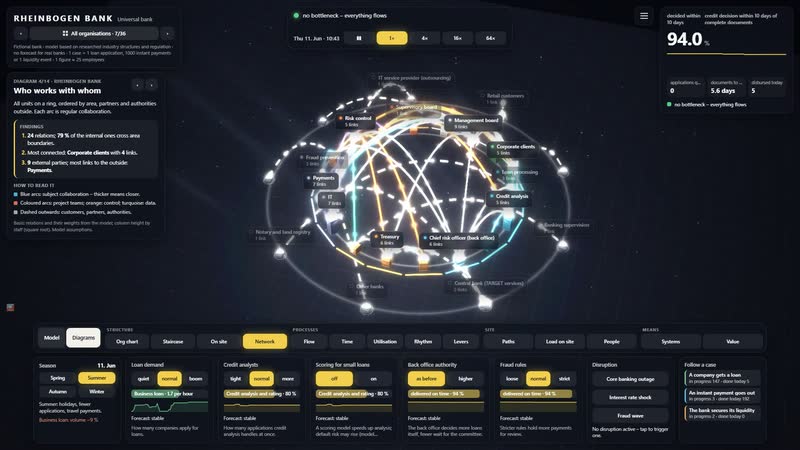
‘Who works with whom’ as a dome of arcs – one of 14 diagrams calculated live from the same data.
08
The whole software
Situation, key figure, time-lapse, six views, controls and disruptions: one click on a department shows its task, location and all relations.
What you can change
Controls
- Loan demand: How many companies apply for loans.
- Credit analysts: How many applications credit analysis handles at once.
- Scoring for small loans: A scoring model speeds up analysis; default risk may rise (model assumption).
- Back office authority: The back office decides more loans itself, fewer wait for the committee.
- Fraud rules: Stricter rules hold more payments for review.
Disruptions
- Core banking outage: The core banking system is down for two hours: no bookings, no disbursements, payments pile up. Severe IT incidents must be reported to the supervisor.
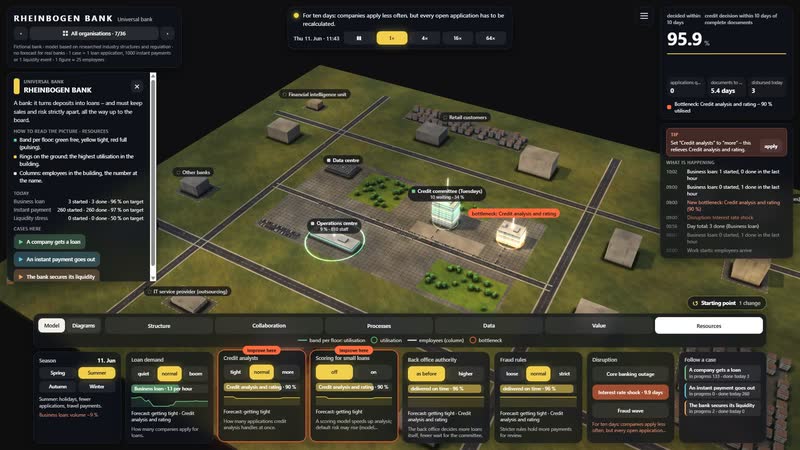
- Interest rate shock: For ten days: companies apply less often, but every open application has to be recalculated.
- Fraud wave: A day of new fraud patterns: every manual review takes three times as long.
What the model gives a bank
-
01
A separation you can walk through
Sales and risk sit in two buildings. Walking between them, people grasp the separation the supervisor requires without reading an org chart.
-
02
Where the ten days go
The simulation runs queues in front of rating, collateral and committee. ‘Where the time goes’ shows where an application is waiting right now.
-
03
Seconds next to days
Instant payments with payee verification and fraud screening run in the same model as the loan process, which takes days.
-
04
Rehearse a crisis
Core banking outage, interest rate shock, fraud wave: trigger three disruptions and watch what they do to the queues.
-
05
For committees and classrooms
Runs in the browser and on large projections; on first start a guided tour walks through the views and diagrams.
-
RHEINBOGEN BANK in the morning – low sun, long shadows, the first commuters on their way in. -
Rheinbogen Tower in evening light – golden arcs show who reports to whom. -
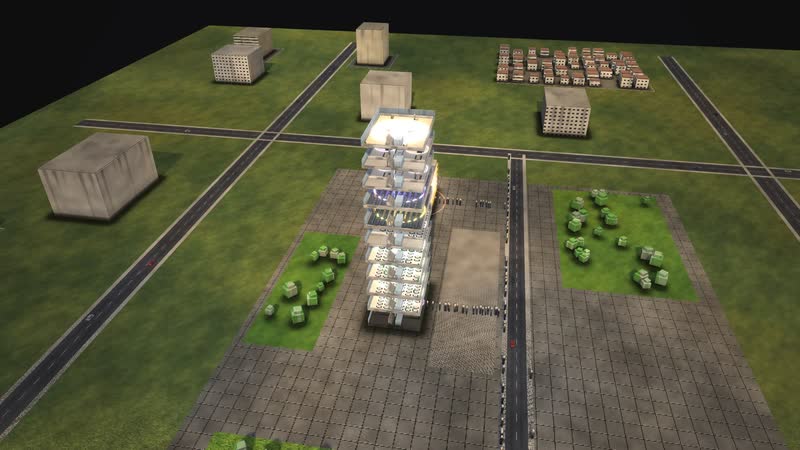
Just before eight – people stream from the car park and the street into the buildings. -
Blue hour – the windows of RHEINBOGEN BANK light up. -
At night from above – Rheinbogen Tower opened up, data lines glowing across the site. -
Rheinbogen Tower opened up – every floor with workplaces and people. -
Dusk, performance view – rings of light show how busy each department is. -
Looking into the floor of Corporate clients – rows of desks, the floors above as outlines of light. -
A room of its own – Management board. -
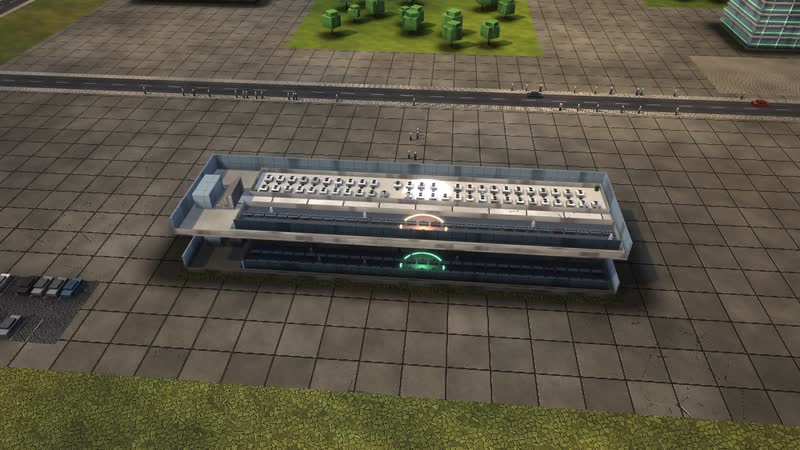
Risk house (back office) opened up – every floor with workplaces and people. -
Operations centre – all floors at once, performance view. -
Structure at dusk – golden arcs from every floor to the buildings reporting to it. -
Collaboration – Corporate clients with all 4 relations – to departments, buildings and partners. -
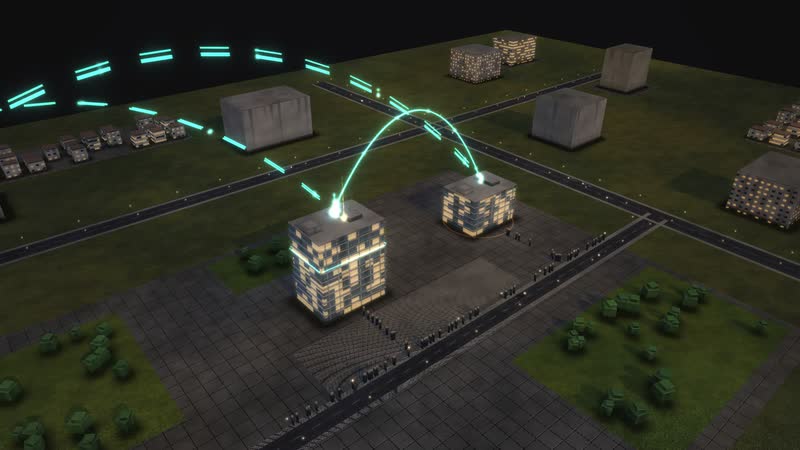
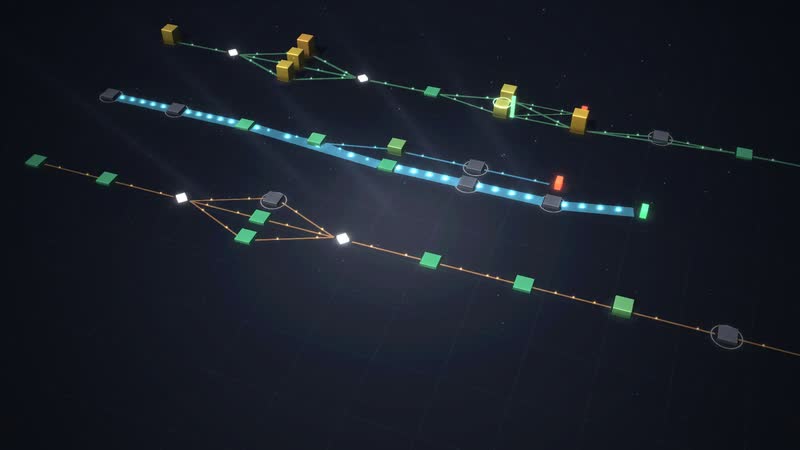
Data flows at night – systems and users linked by glowing lines. -
Data flows at dusk – which department uses which system. -
Structure across the whole site – reporting lines between the buildings. -
The whole network at night – collaboration inside and far beyond. -
Every step labelled – name, how many are waiting, utilisation. -
Following one case – ‘A company gets a loan’ – step by step through the building. -
Interest rate shock – resources view, the backlog grows floor by floor. -
Core banking outage – the data arcs turn red, work stalls. -
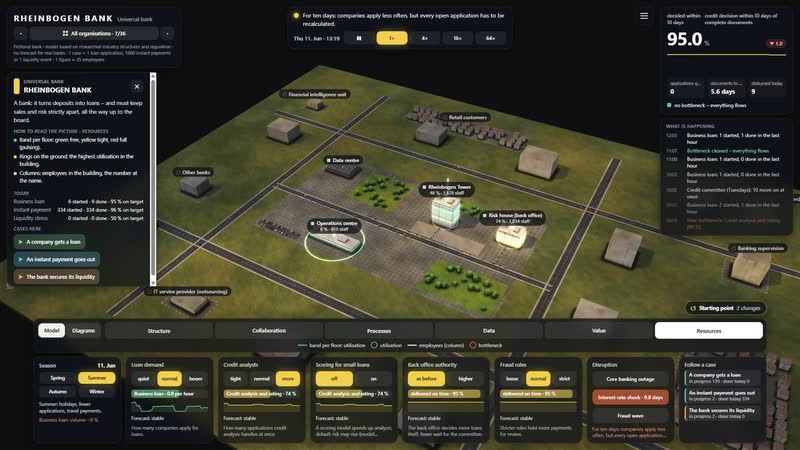
The lever – Credit analysts set to ‘more’ – a flash shows where it acts. -
Spring at RHEINBOGEN BANK – Rheinbogen Tower opened up, rings show the workload. -
Summer evening – warm light, long shadows, golden arcs above the square. -
Autumn – leaves on the paths, performance view. -
Winter evening – snow on the site, Rheinbogen Tower open and lit, collaboration glowing. -
Diagram ‘Who works with whom’, calculated live from the model. -
Diagram ‘Year, week, day’, calculated live from the model. -
Diagram ‘Management levels as a staircase’, calculated live from the model. -
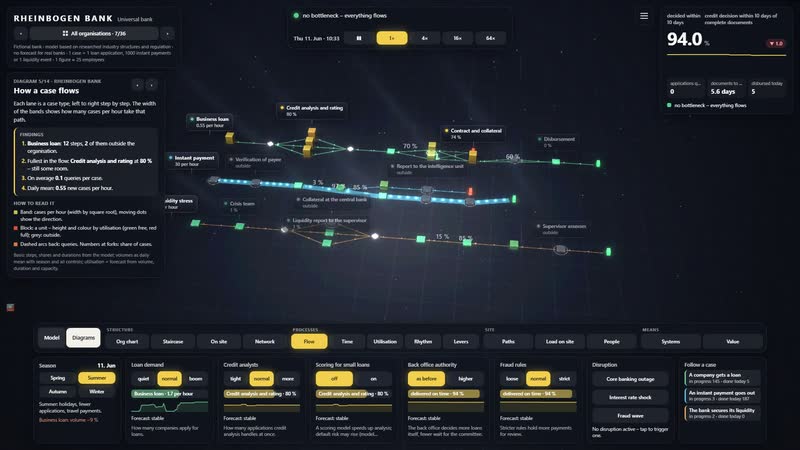
Diagram ‘How a case flows’, calculated live from the model. -
Diagram ‘What each control does’, calculated live from the model. -
Diagram ‘What the work depends on’, calculated live from the model. -
Diagram ‘Where it gets tight’, calculated live from the model. -
Diagram ‘Who leads whom’, calculated live from the model. -
The whole software – situation, key figure, time, views and the controls below. -
Rheinbogen Tower selected – floor list on the right, the floors drift apart. -
Corporate clients – card with task, location and all relations. -
Interest rate shock triggered – timeline, key figure and bottleneck react. -
Countering – Credit analysts increased – the tile shows the effect since the change. -
Diagram ‘How a case flows’ with its panel – findings in sentences. -
Diagram ‘Who works with whom’ with its panel. -
Follow a case – step, waiting time and target on the card. -
The tour leads through the software in eight steps. -
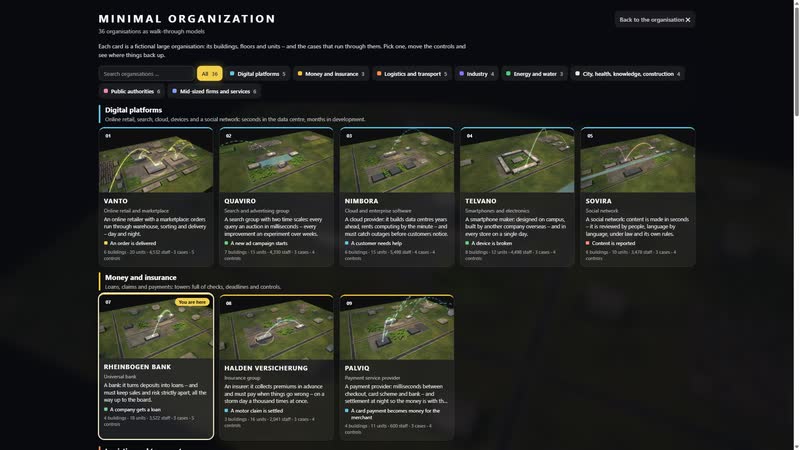
36 organisations to choose from, each with its own picture.
















Your bank as a model
Would you like to see your loan process, authority rules or payments operation like this? Contact us by email or phone and we'll discuss which data the model needs. On request you'll also receive the password to open RHEINBOGEN BANK yourself.
cube4tec.de/spiele/minimal-organization/
Ask about this
Minimal Organization: Bank
Basis and limits
Fictional bank · model based on researched industry structures and regulation · no forecast for real banks
1 case = 1 loan application, 1000 instant payments or 1 liquidity event · 1 figure ≈ 25 employees
All volumes, durations, rates and capacities are model assumptions, not values of a real bank.
The authority limit (back office or committee) and the effect of scoring are model assumptions.
Documented: separation of front and back office up to the board, second vote, three lines of defence, 10-second target and payee verification for instant payments.
Public sources the model is based on:
- Kreditwesengesetz §§ 25c, 25d
- BaFin: Mindestanforderungen an das Risikomanagement (MaRisk)
- EBA Guidelines on Internal Governance (EBA/GL/2021/05)
- EZB: TARGET-Dienste (T2, TIPS)
- Verordnung (EU) 2024/886 (Echtzeitüberweisungen)
- Verordnung (EU) 2022/2554 (DORA)
- Geldwäschegesetz
Similar business models
-
Insurance company
An insurer as a walkable model: a motor claim runs straight through or via claims handler, loss adjuster and workshop to payment and recovery.
-
Payment service provider
A payment service provider as a walkable model: a card payment from authorisation in milliseconds to the payout to the merchant in the morning.
-
Tax office
A tax office as a walkable model: how an income tax return travels from receipt to notice, where it waits and what speeds up processing.
-
Health insurer
A statutory health insurer as a walkable model: how a wheelchair application moves from quote to decision, when the medical service steps in and where deadlines get tight.
-
Special machine builder
A family-owned special machine builder as a walkable model: how a custom packaging line moves from enquiry to site acceptance and where the 28 weeks go.
-
Online retail
An order from click to doorstep as a walkable model: payment check, warehouse, packing, trucks, sortation and delivery in a running simulation.
-
Search engine
A search and advertising group as a walkable model: auctions in milliseconds, experiments over weeks, and a new ad campaign that waits for people.
-
Cloud provider
A cloud provider as a walkable model: support cases, zone outages and new data centres on three time scales, in a running simulation.







All data are fictional – RHEINBOGEN BANK does not exist. The model can be fitted to your bank's real data and filled with what is visible nowhere today: lead times by loan type and authority level, or applications per analyst and committee date.