
Simulation · Minimal Organization · Public authorities
Police authority
A city police authority as a walkable model: what happens after an emergency call, how many patrols it takes and what shortens the time to arrival.
Trailer
All data are fictional, including call volumes and arrival times. The model can be adapted to your authority's real data and extended with information that is nowhere visible in one place today – for example calls per hour and district, or arrival times per station.
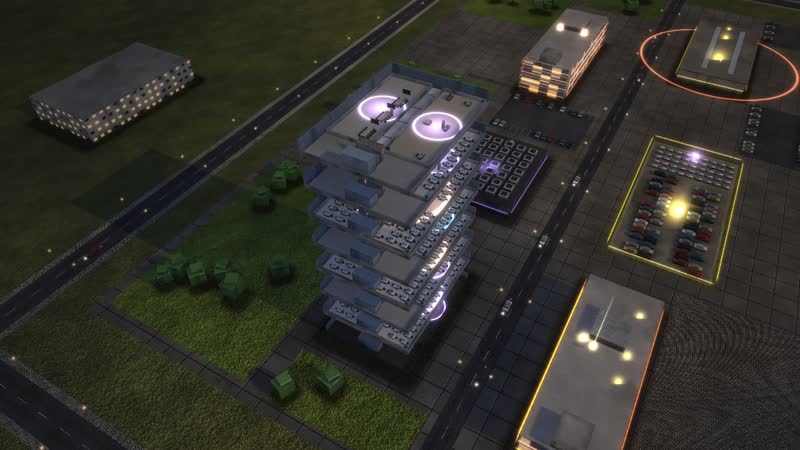
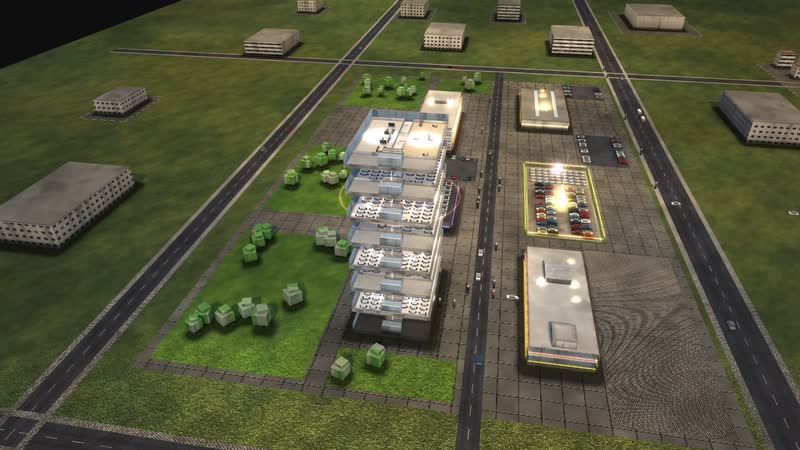
This police dispatch simulation shows the fictional POLIZEIPRÄSIDIUM WESTERBRÜCK, a city police authority with seven buildings and 20 departments. The control centre takes every emergency call, patrols drive around the clock – and behind every report is an investigation for the prosecutor.
The main process starts when a neighbour hears glass breaking and dials 110, Germany's police emergency number. The control centre asks what happened, the dispatch system proposes the nearest available patrol, and the car drives with blue lights and siren. The target is measured on scene: a patrol within 15 minutes. That is a model value, since German law sets no response time for the police. Then the criminal investigation watch, the ambulance service or the duty judge takes over – and the patrol writes its report.
A crime report on its way to the prosecutor, a rear-end collision on the ring road and a football match with many away fans run alongside. This page is meant for police leadership, control room managers, duty and operations planners, trainers and press officers.
An emergency call: a burglary in a flat
- 01
Someone dials 110: A neighbour hears glass breaking and dials 110.
- 02
Emergency call taking: The control centre asks: what happened, where, is anyone in danger?
- 03
Dispatch: The dispatch system proposes the nearest free patrol; the dispatcher alerts it by radio.
- 04
Driving with blue lights: The patrol drives with blue lights and siren.
- 05
Patrol at the scene: The patrol is on scene: secure, help, take details. This is where the target is measured.
- 06
Ambulance takes over: The ambulance service takes over the injured.
- 07
Criminal watch: first response: The criminal watch takes over: secure traces, question witnesses, search.
- 08
An investigation begins.
- 09
Police custody: A person is taken into custody.
- 10
Duty judge decides: The duty judge decides on custody or release.
- 11
Incident report at the station: Back at the station the patrol writes the incident report.
- 12
Operation finished.
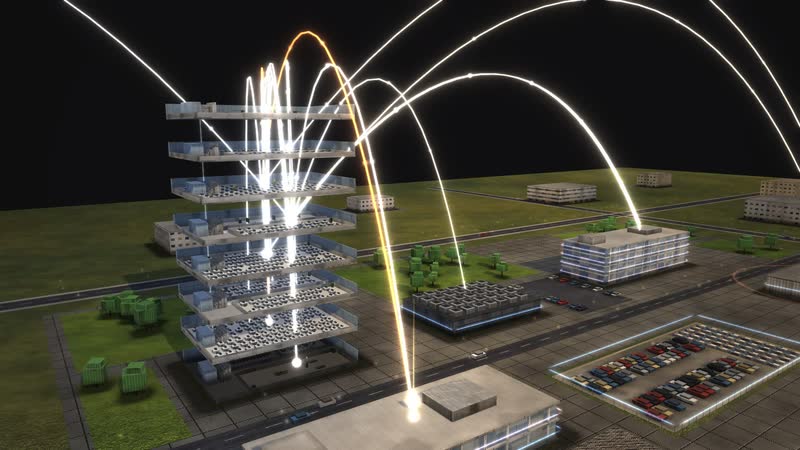
01
A site at work
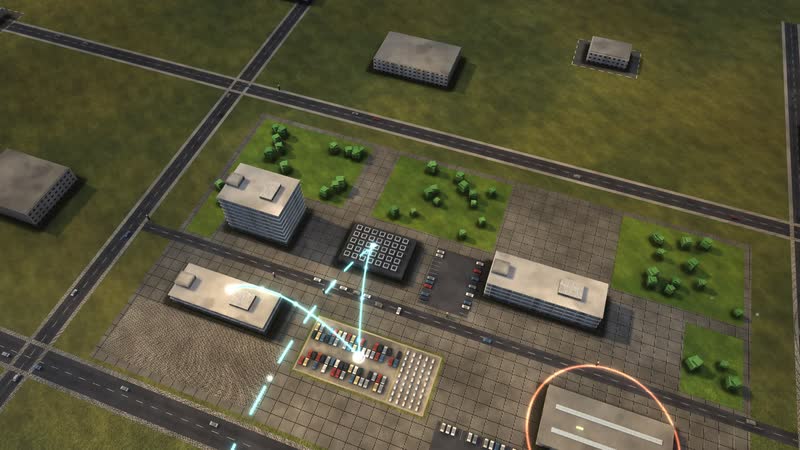
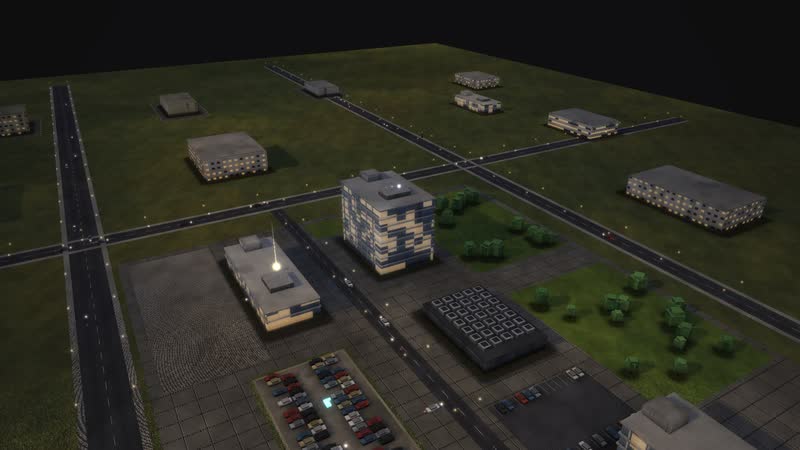
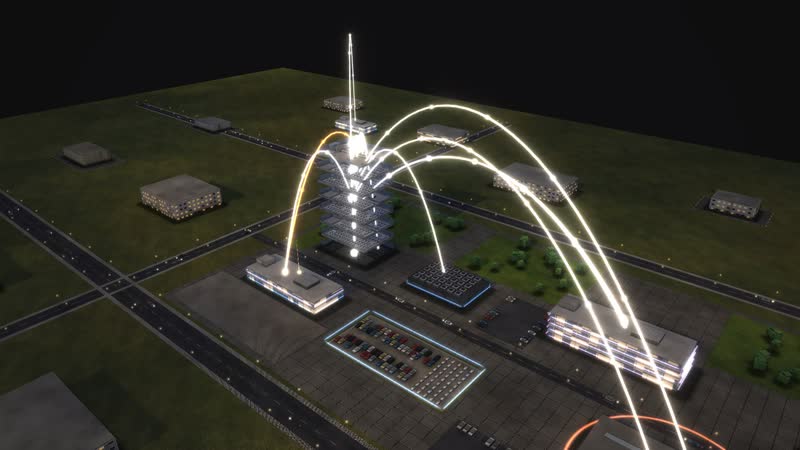
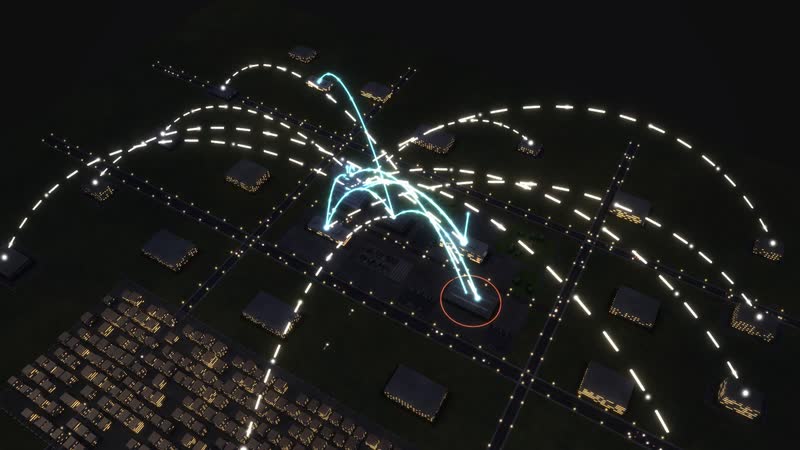
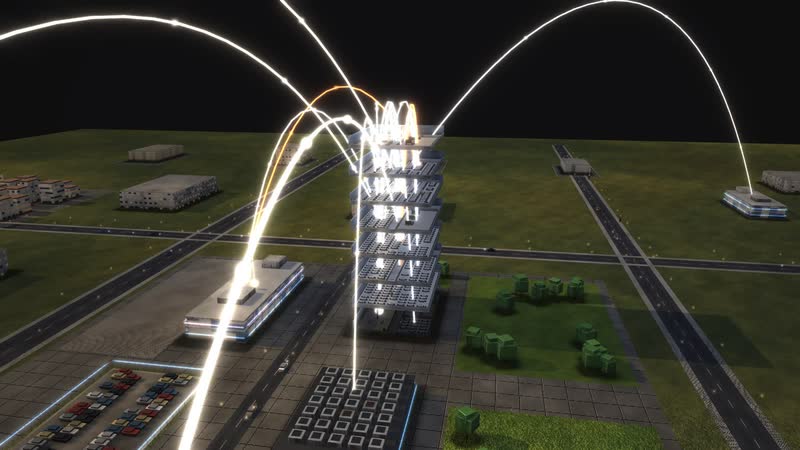
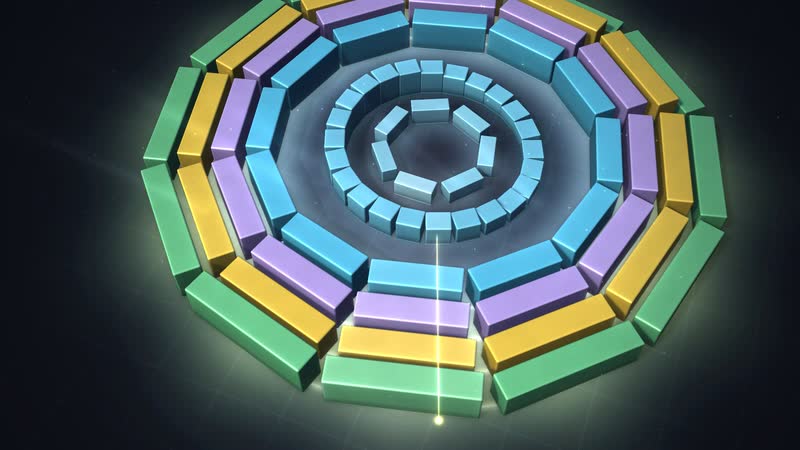
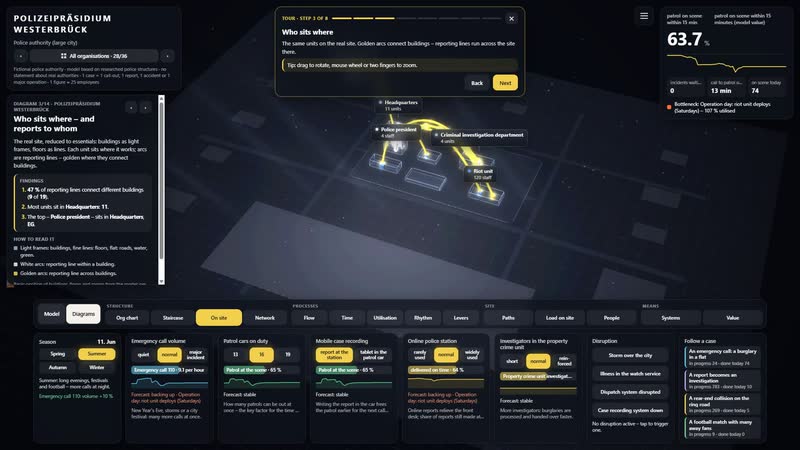
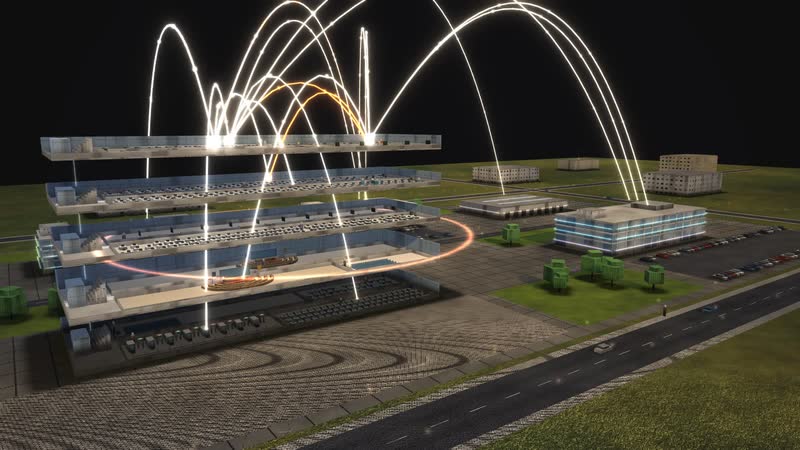
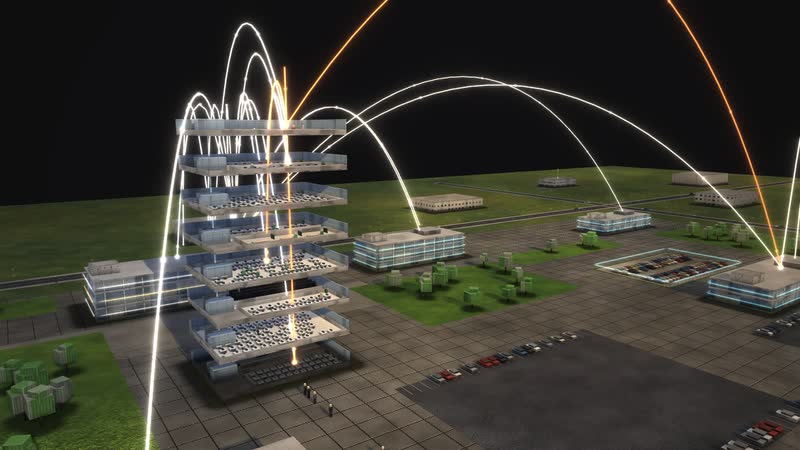
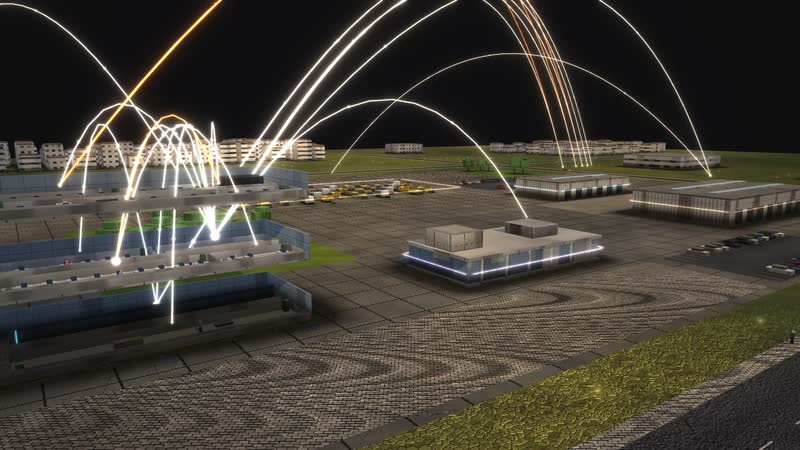
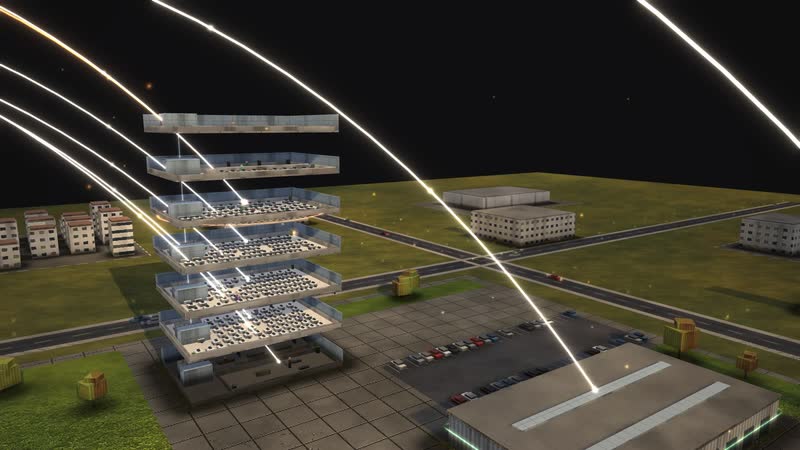
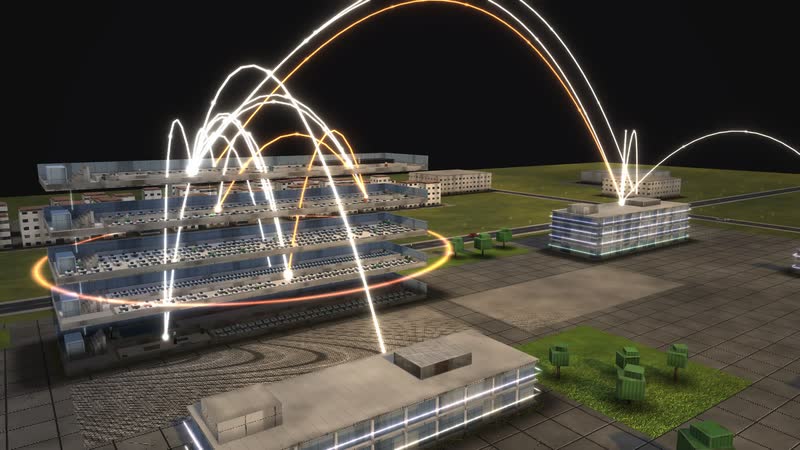
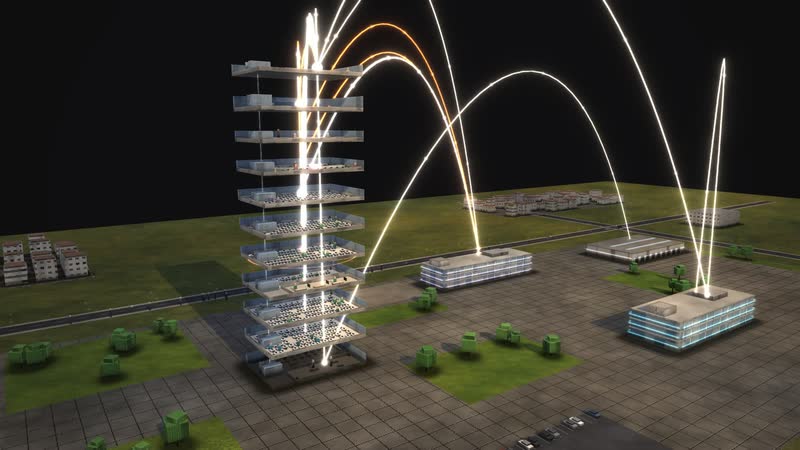
7 buildings, 20 departments, about 970 staff: in the evening light golden arcs show who reports to whom.
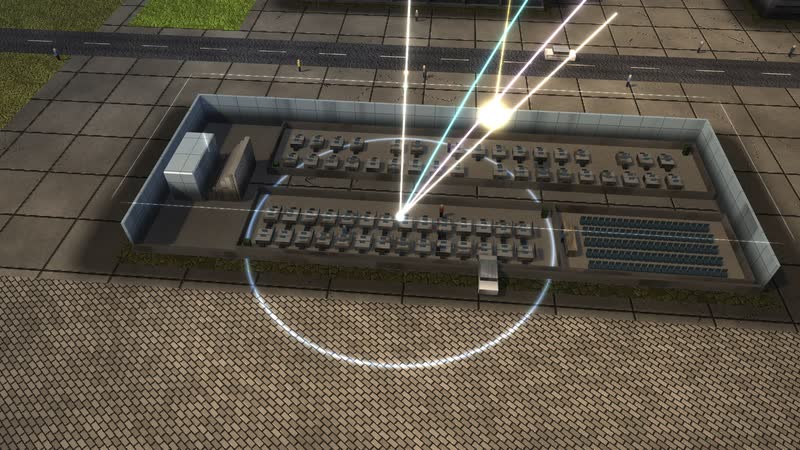
02
Every floor opened up
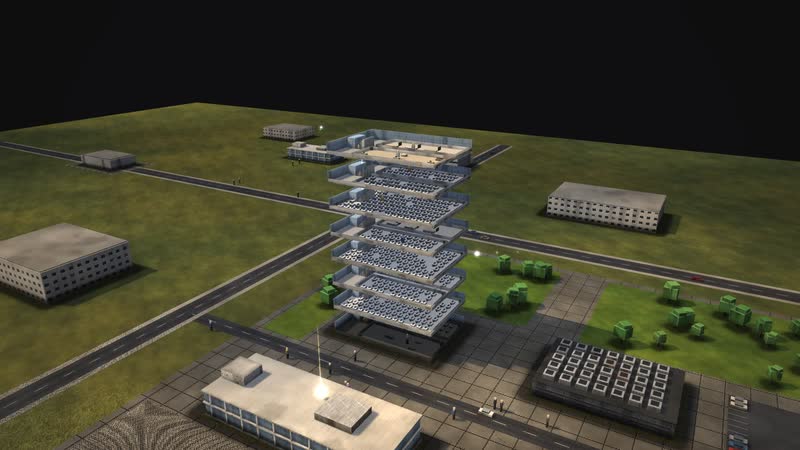
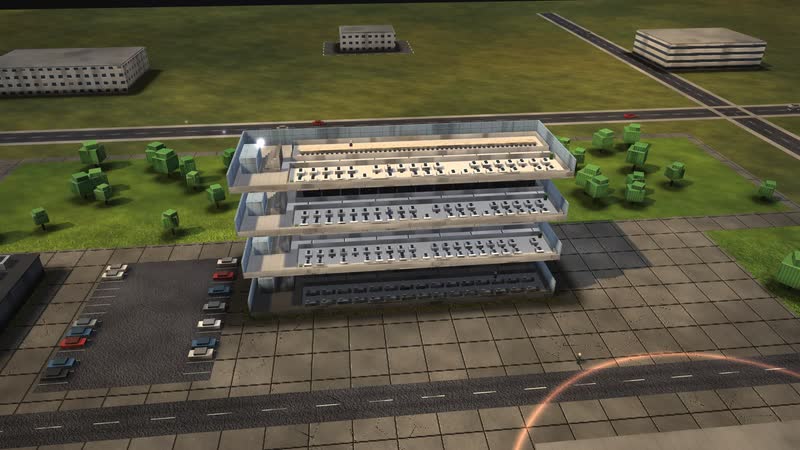
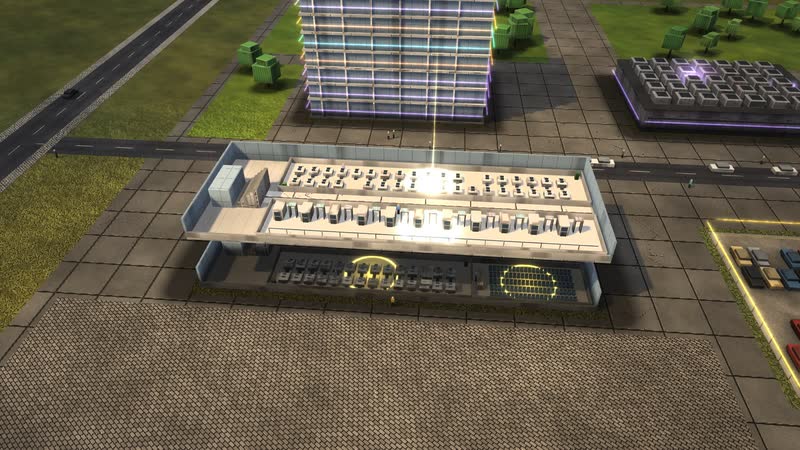
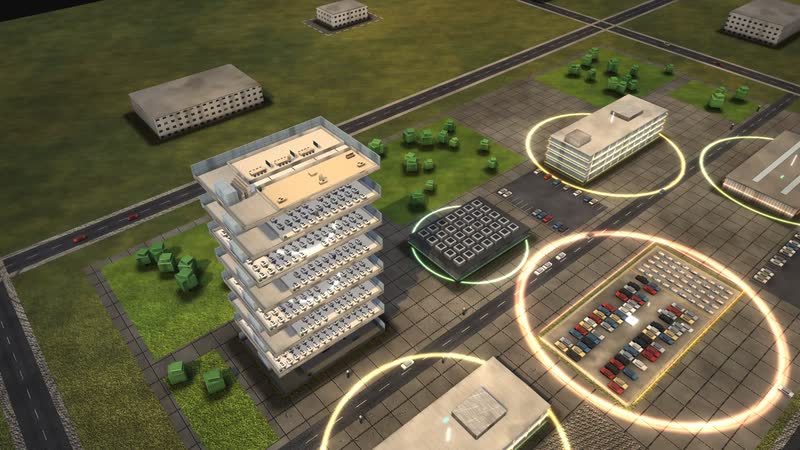
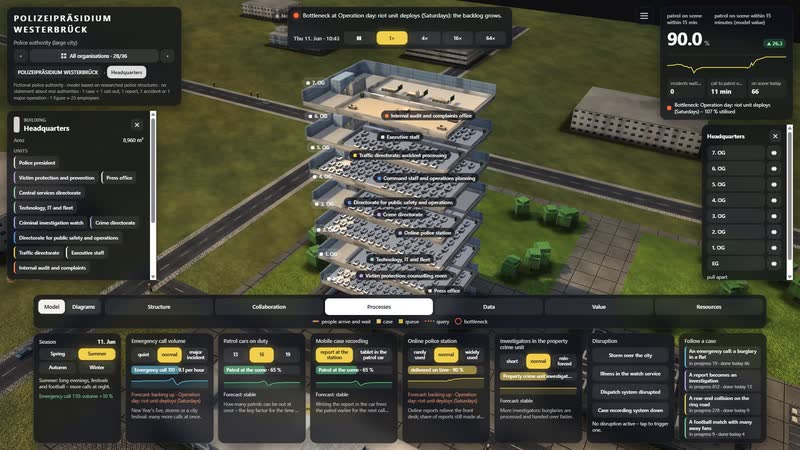
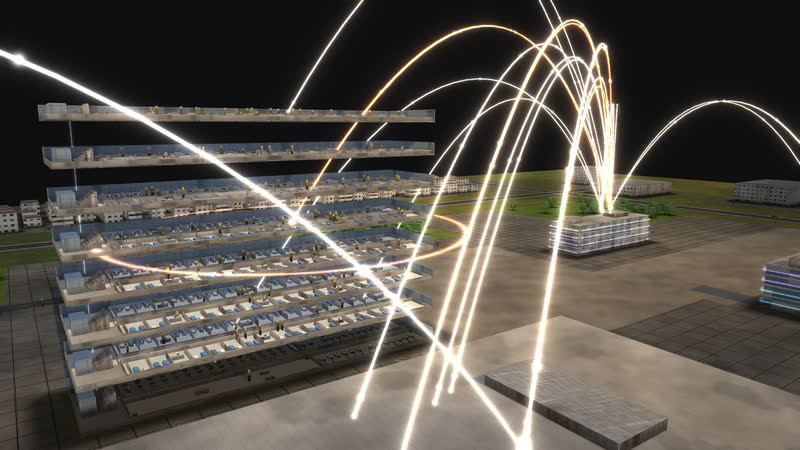
Every building can be opened, floor by floor – right into single rooms such as ‘Central police station’, with workplaces and people at work.
What is shown – why – for whom
| What is shown | Why | For whom |
|---|---|---|
| ‘The path across the site’ diagram: control centre, stations, incident locations | WhyShows the patrols' routes to the scene. | For whomPolice leadership, control centre |
| ‘Where it gets tight’ diagram: no patrol car available | WhyShows the limit of the patrol service. | For whomOperations directorate |
| ‘What each control does’ diagram: patrols, mobile reporting, online police station, investigators | WhyRanks the levers for arrival time. | For whomPolice leadership, interior ministry |
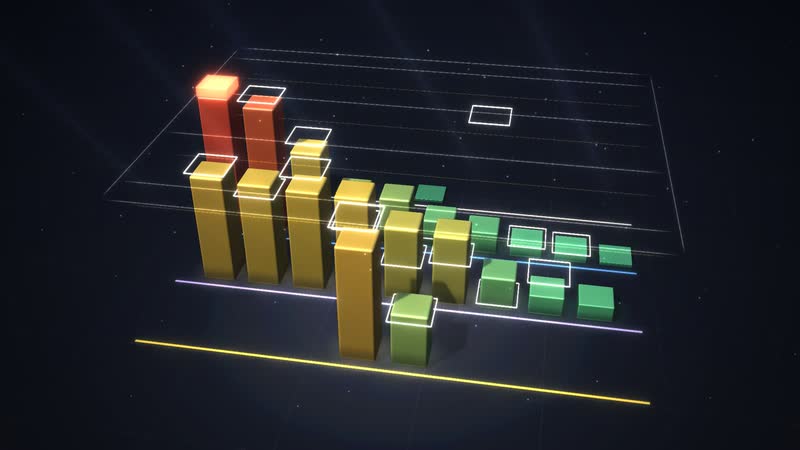
| ‘Year, week, day’ diagram: nights, weekends, major incidents | WhyShows the peaks in call-outs. | For whomDuty planning |
| ‘Where people work’ diagram | WhyShows headquarters, stations and criminal investigation. | For whomRecruitment, the public |
| Process ‘A report becomes an investigation’ | WhyShows the path to the public prosecutor. | For whomCriminal investigation, training |
| Process ‘A football match with many away fans’ | WhyShows a planned major operation. | For whomOperations planning, city |
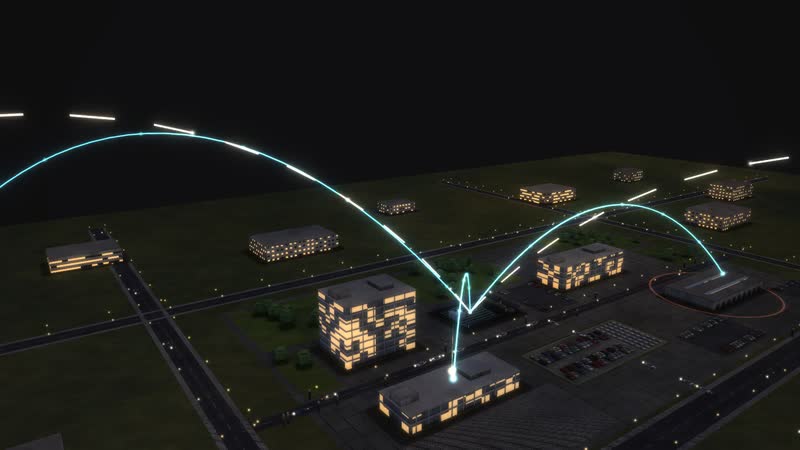
03
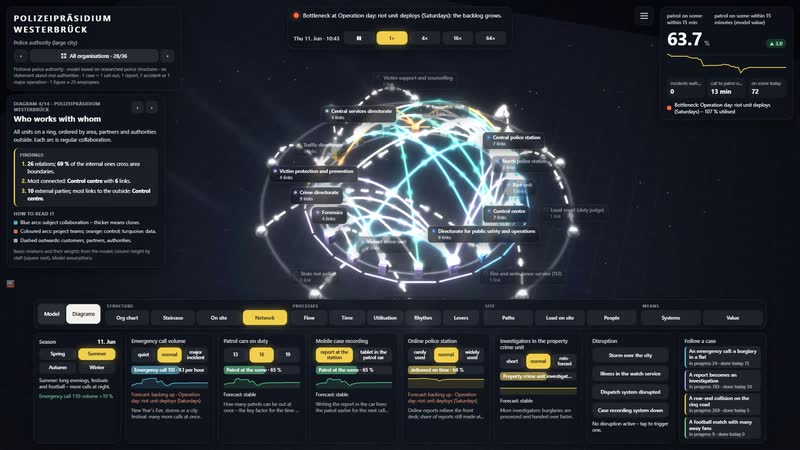
Who works with whom
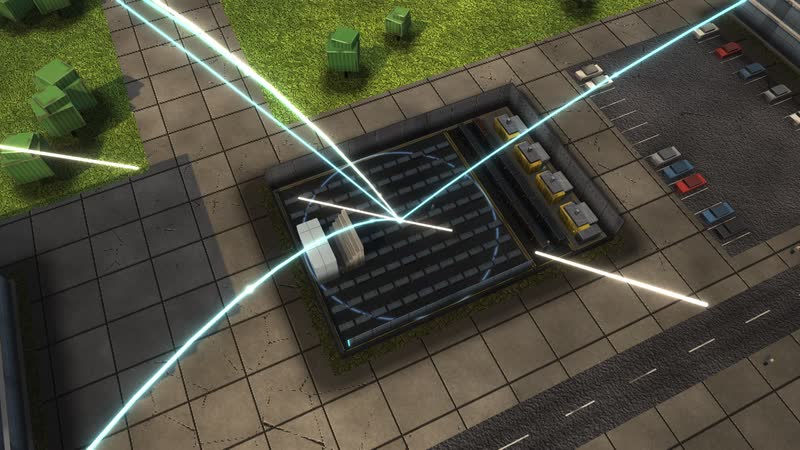
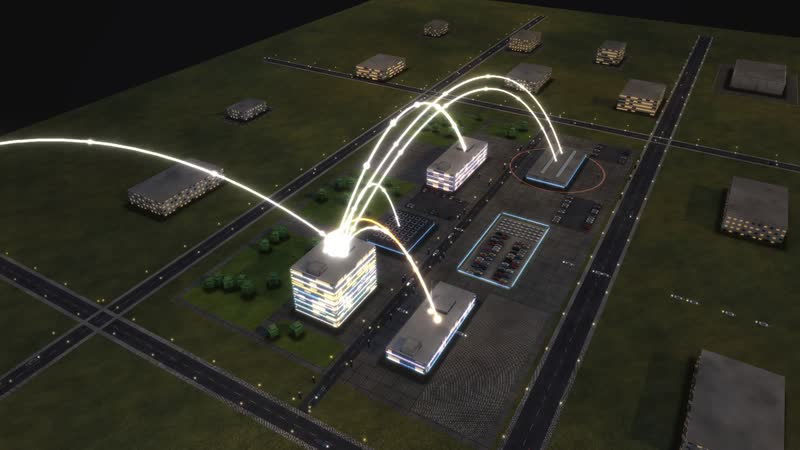
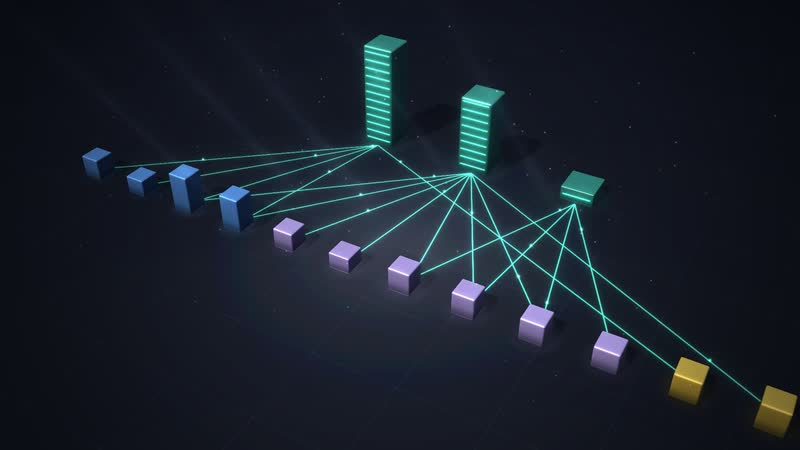
‘Control centre’ with all 6 relations: Central police station, North police station, Accident investigation team and Technology, IT and fleet – and outside City area · population and Fire and ambulance service (112).
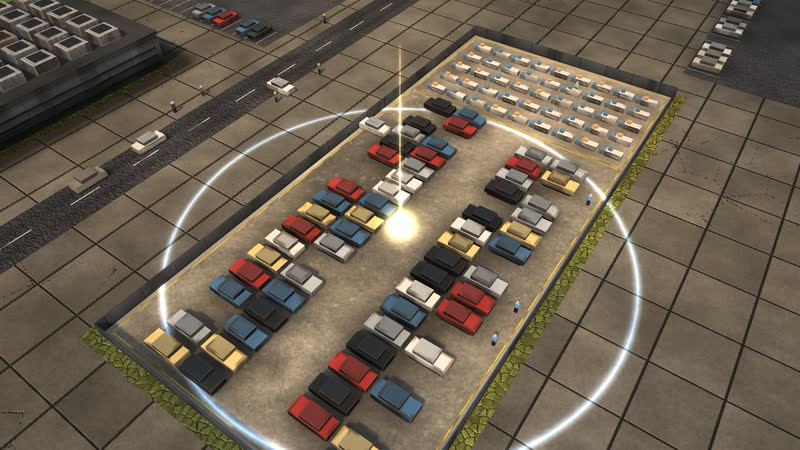
04
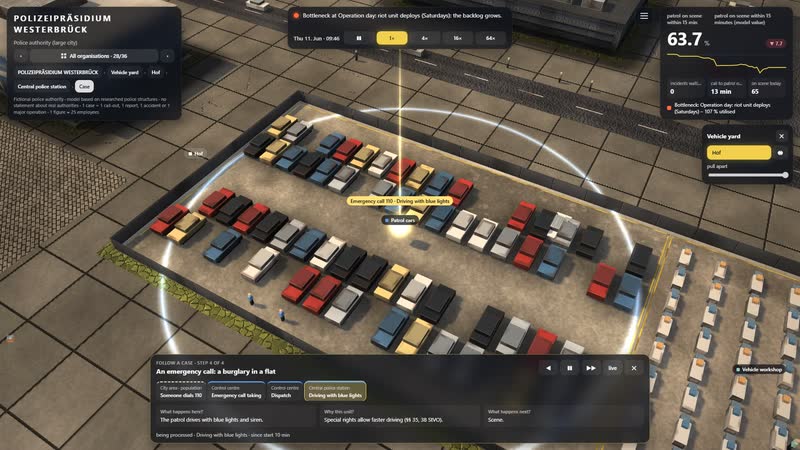
An emergency call: a burglary in a flat
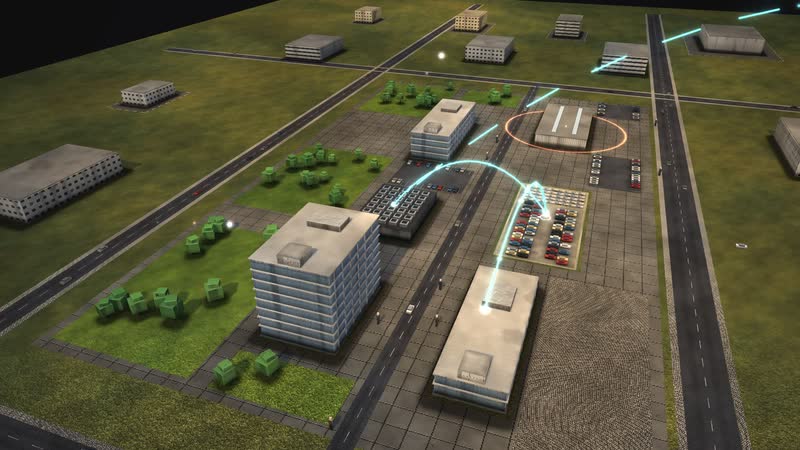
A single case can be followed – step by step, with the waiting time at every station. Target: patrol on scene within 15 minutes (model value).
Films from the model
-
The tower opens up
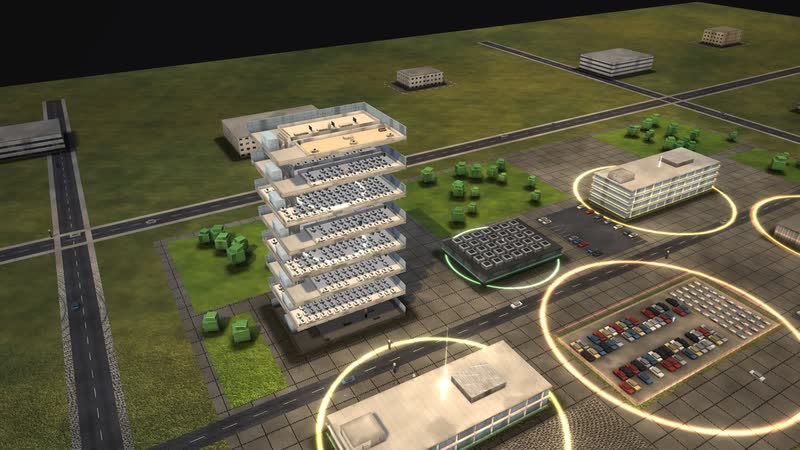
Just before sunset the floors drift apart – ‘Headquarters’ opens up as the camera rises and circles the building until night falls.
-
Who reports to whom, who works with whom
Blue hour above the site: first the golden arcs of the structure, then the collaboration of the most connected department, finally the whole building.
-
A day in time-lapse
From ten in the morning to midnight in 26 seconds: the sun moves, the windows light up, at night the data lines glow.
-
Surge and system outage
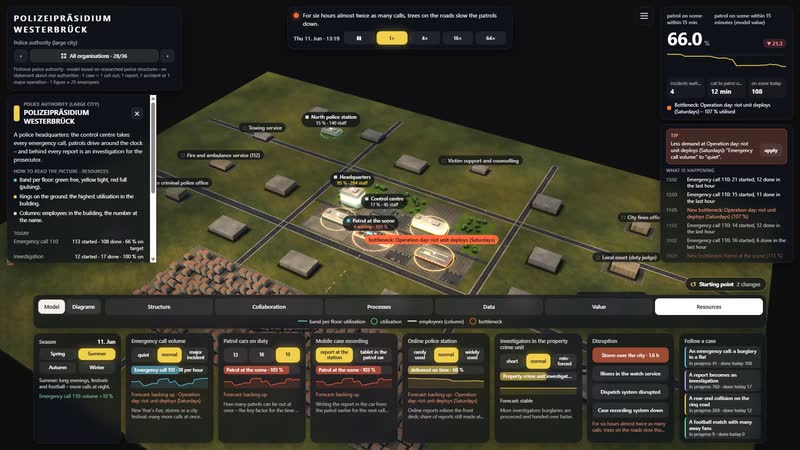
In time-lapse: ‘Storm over the city’ brings more work, then ‘Case recording system down’ – the data arcs turn red. The control ‘Patrol cars on duty’ set to ‘19’ brings recovery.
-
Seven diagrams
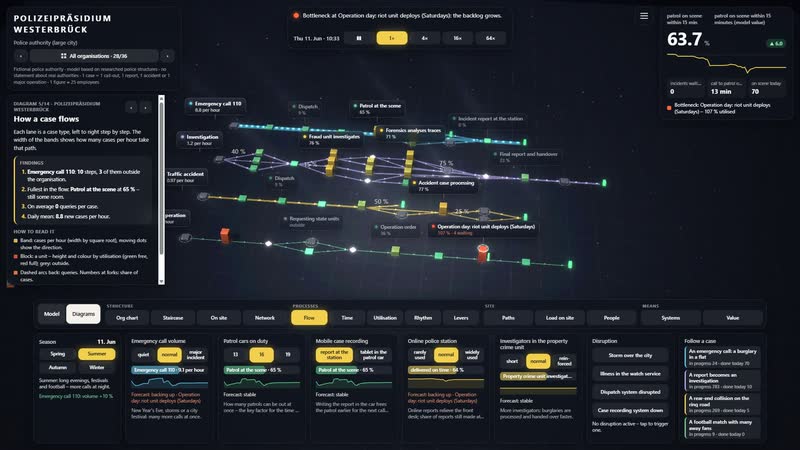
Calculated live from the model: ‘Who works with whom’, ‘Year, week, day’, ‘Management levels as a staircase’, ‘How a case flows’, ‘What each control does’, ‘What the work depends on’, ‘Where it gets tight’.
-
Using the software
With the full interface: open a building, a department’s relations, ‘Storm over the city’, a control, diagrams with their panel, one case.
Departments in the model
-
Police president
Heads the authority; responsible for operations, investigations and administration.
-
Executive staff
Controlling, strategy, situation picture, cooperation with city and state.
-
Press office
Informs the public, warns about scams, accompanies major operations.
-
Directorate for public safety and operations
Leads stations, control centre and riot unit; plans major operations.
-
Control centre
Takes every 110 call and sends the nearest free patrol – around the clock.
-
Central police station
Shift service: patrols, reports at the desk, custody.
-
North police station
Watch and community service in the north of the city.
-
Riot unit
Formed unit for matches, assemblies and major incidents.
-
Crime directorate
Leads the criminal police and assigns investigations.
-
Criminal investigation watch
Around the clock first response: traces, witnesses, search; plus the online police station.
-
Property crime unit
Burglary, theft, handling stolen goods.
-
Fraud and cybercrime unit
Phone and internet fraud, digital evidence.
-
Violent crime unit
Assault, robbery, domestic violence.
-
Forensics
Secures and examines traces: fingerprints, tool marks, DNA samples for the state office.
-
Victim protection and prevention
Advises those affected, refers to support, advises on burglary protection.
-
Traffic directorate
Accident processing, traffic enforcement, accident prevention.
-
Accident investigation team
Records accidents: traces, sketch, witnesses, cautions.
-
Central services directorate
Staff, budget, legal, buildings.
-
Technology, IT and fleet
Radio, dispatch system, patrol cars, workshop.
-
Internal audit and complaints
Audits processes and takes complaints about police operations – independent of the directorates, reporting directly to the head.
05
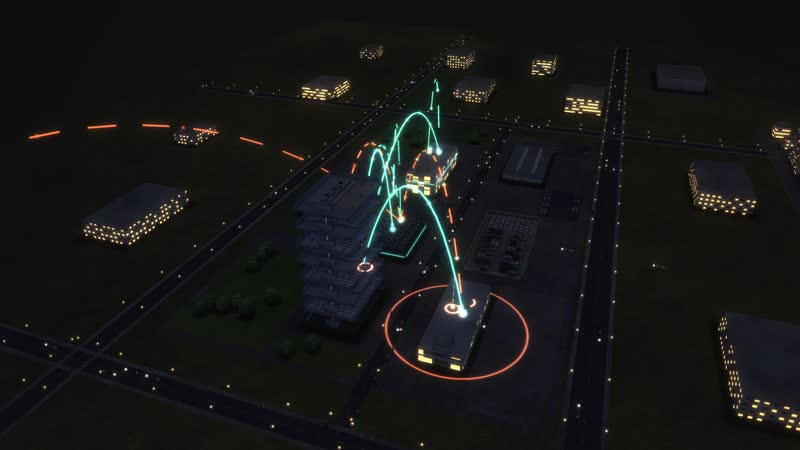
Case recording system down
The data arcs turn red and work stalls – the simulation shows where cases pile up and how long recovery takes.
06
A day in 26 seconds
From ten in the morning to midnight in time-lapse: commuters, moving light, windows switching on – and at night the data lines.
All processes in the model
An emergency call: a burglary in a flat
- 01Someone dials 110: A neighbour hears glass breaking and dials 110.
- 02Emergency call taking: The control centre asks: what happened, where, is anyone in danger?
- 03Dispatch: The dispatch system proposes the nearest free patrol; the dispatcher alerts it by radio.
- 04Driving with blue lights: The patrol drives with blue lights and siren.
- 05Patrol at the scene: The patrol is on scene: secure, help, take details. This is where the target is measured.
- 06Ambulance takes over: The ambulance service takes over the injured.
- 07Criminal watch: first response: The criminal watch takes over: secure traces, question witnesses, search.
- 08An investigation begins.
- 09Police custody: A person is taken into custody.
- 10Duty judge decides: The duty judge decides on custody or release.
- 11Incident report at the station: Back at the station the patrol writes the incident report.
- 12Operation finished.
A report becomes an investigation
- 01A resident reports a crime: After their holiday a family finds their cellar broken into. They report it – at the station or online.
- 02Report at the front desk: At the front desk an officer records the report.
- 03Report at the north station: The north station records the report.
- 04Online station checks the report: The online station checks the online report.
- 05Crime directorate assigns: The crime directorate assigns the case by offence.
- 06Property crime unit investigates: The property crime unit investigates: scene, witnesses, comparison with similar cases.
- 07Forensics and interviews run at the same time.
- 08Forensics analyses traces: Forensics analyses fingerprints and tool marks.
- 09DNA analysis at the state office: The state office analyses the DNA and compares it with the database.
- 10Interview: Witnesses and victims are interviewed.
- 11Traces and statements are in.
- 12Again: Interview: The victims are interviewed, stolen goods are put on the wanted list.
- 13Fraud unit investigates: The fraud unit traces accounts and phone numbers.
- 14Again: Interview: Interviewing victims and suspects.
- 15Violent crime unit investigates: The violent crime unit secures statements and medical reports.
- 16Interview and victim protection run at the same time.
- 17Again: Interview: Interviewing witnesses and suspects.
- 18Victim protection advises: The victim protection officer arranges counselling and support.
- 19Statements and support are arranged.
- 20Final report and handover: Final report: the file goes to the prosecutor.
A rear-end collision on the ring road
- 01Accident reported via 110: In rush hour one car runs into another. A driver calls 110.
- 02Emergency call taking: The control centre takes the call.
- 03Dispatch: An accident investigation team is alerted.
- 04Driving with blue lights: The team drives to the scene.
- 05Recording the accident on site: The team secures the scene, photographs traces, takes details.
- 06Caution fee paid, details exchanged.
- 07Towing service clears: A towing service clears the car from the road.
- 08Accident case processing: Accident processing hears those involved and evaluates traces.
- 09Fines office issues the notice: The city's fines office issues the notice.
- 10Prosecutor decides: The prosecutor examines the injury case.
- 11Closed.
A football match with many away fans
- 01Organiser registers the match: The club registers a match with many away fans.
- 02Command staff plans the operation: The command staff plans forces, areas and times: arrival, match, departure.
- 03Requesting forces and the safety meeting run at the same time.
- 04Requesting state units: The headquarters requests units from the state riot police.
- 05Safety meeting: Safety meeting with club, city, fire service and public transport.
- 06Forces confirmed, agreements made.
- 07Operation order: The operation order sets sectors, radio and responsibilities.
- 08Press office informs: The press office announces road closures and advice for fans.
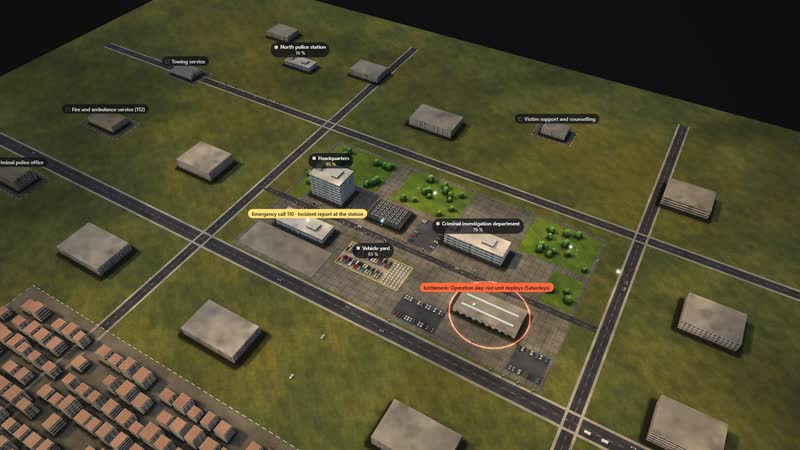
- 09Operation day: riot unit deploys (Saturdays): Match day: the riot unit deploys and accompanies arrival and departure.
- 10Closing debrief: Closing debrief on the same day: what went well, what should change next time?
- 11Operation completed.
How a police authority can use the model
-
Internal communication
Headquarters, control centre, two stations, criminal investigation and vehicle yard in a single view. The collaboration view shows how public safety, crime and traffic interlock.
For whomPolice leadership, executive staff, directorates
-
Onboarding
New officers and staff see where a call-out leads after the radio message – station, criminal watch, custody, duty judge – and where their own unit sits in the headquarters.
For whomNew staff in patrol, control room and administration
-
Training
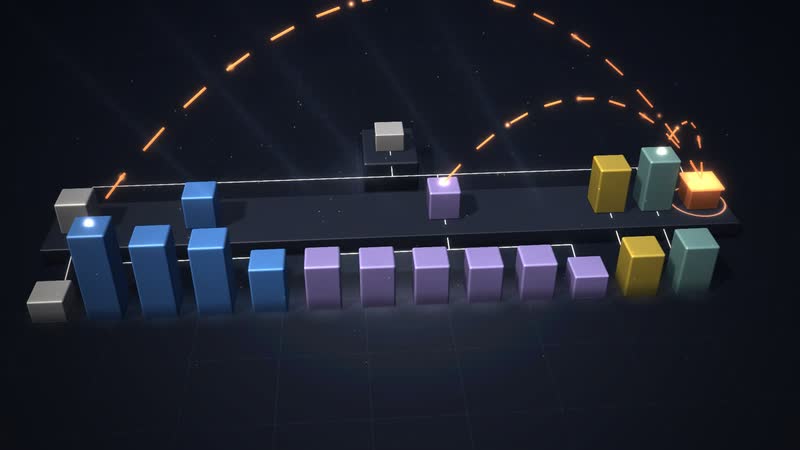
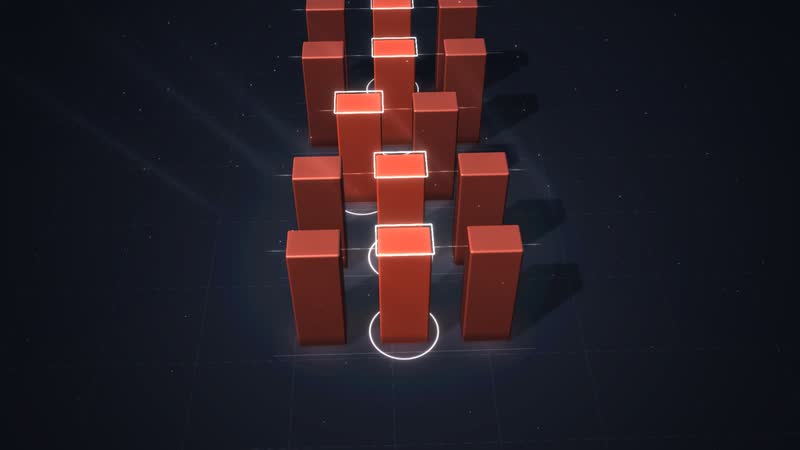
Police cadets play through a storm or run the city with 13 instead of 16 patrols and see in the ‘Where it gets tight’ diagram when no car is left.
For whomBasic and advanced training, police students
-
Explaining to the public
How long until the police arrive, and why? The model shows call taking, dispatch and the drive as one chain – useful for community dialogue and recruitment.
For whomPress office, recruitment, citizens
-
Strategic overview
Patrols on duty, tablets in the car, online police station, investigators: the model sets the levers for arrival time side by side. ‘Year, week, day’ shows nights, weekends and major incidents.
For whomPolice leadership, operations directorate, interior ministry
07
Diagrams from the model
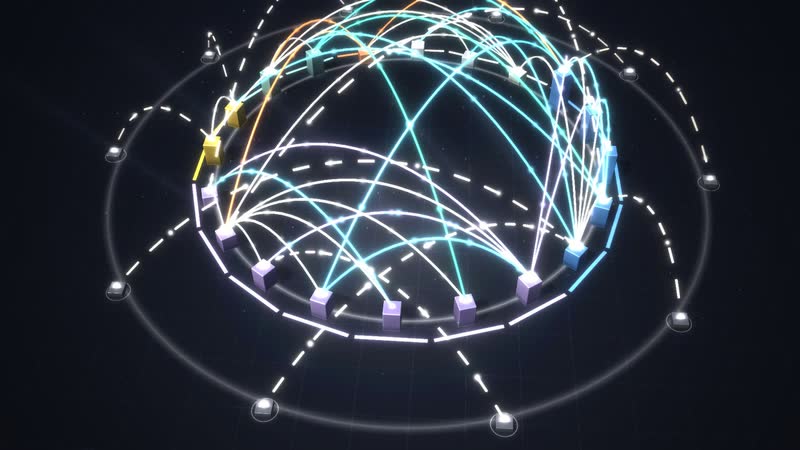
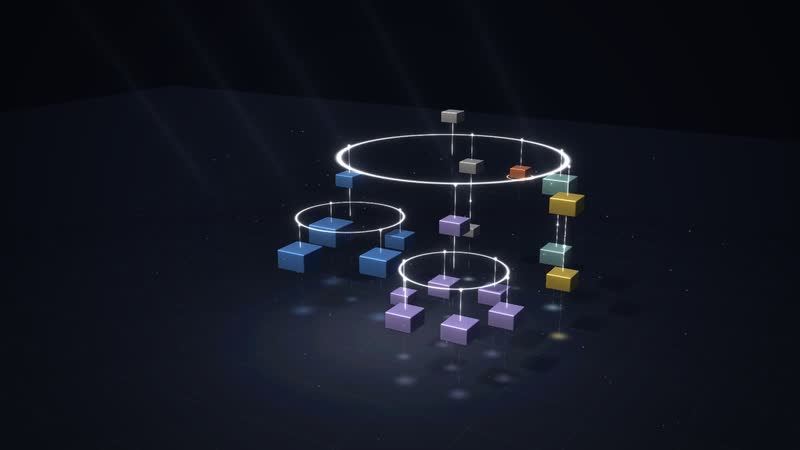
‘Who works with whom’ as a dome of arcs – one of 14 diagrams calculated live from the same data.
08
The whole software
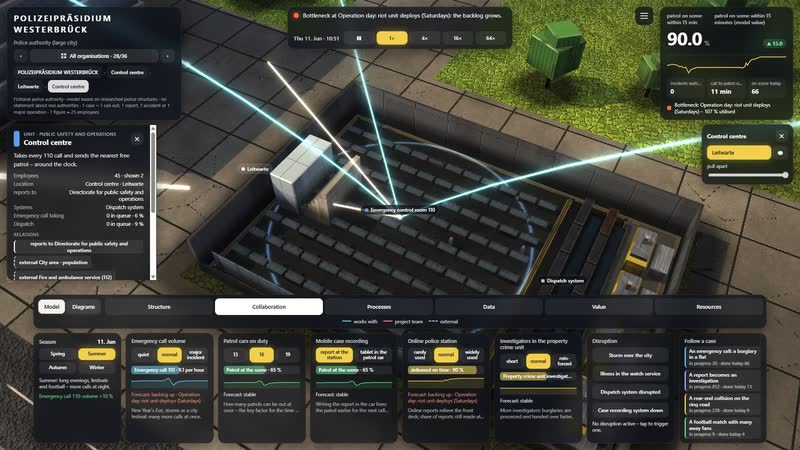
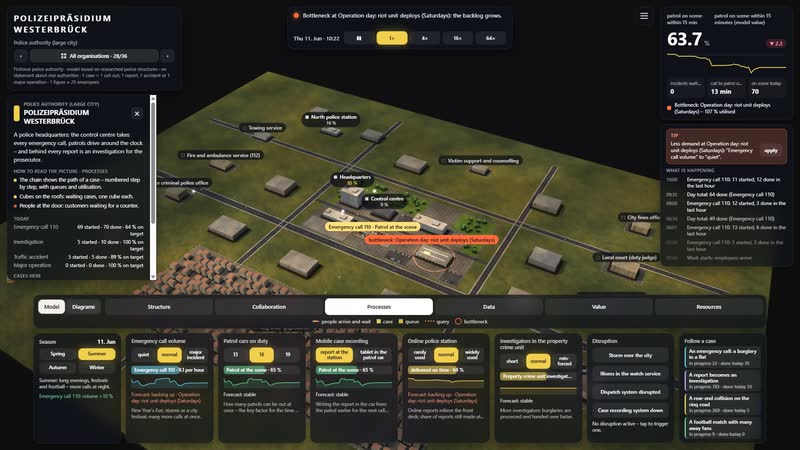
Situation, key figure, time-lapse, six views, controls and disruptions: one click on a department shows its task, location and all relations.
What you can change
Controls
- Emergency call volume: New Year's Eve, storms or a city festival: many more calls at once.
- Patrol cars on duty: How many patrols can be out at once – the key factor for the time to arrival.
- Mobile case recording: Writing the report in the car frees the patrol earlier for the next call (model assumption).
- Online police station: Online reports relieve the front desk; share of reports still made at the desk.
- Investigators in the property crime unit: More investigators: burglaries are processed and handed over faster.
Disruptions
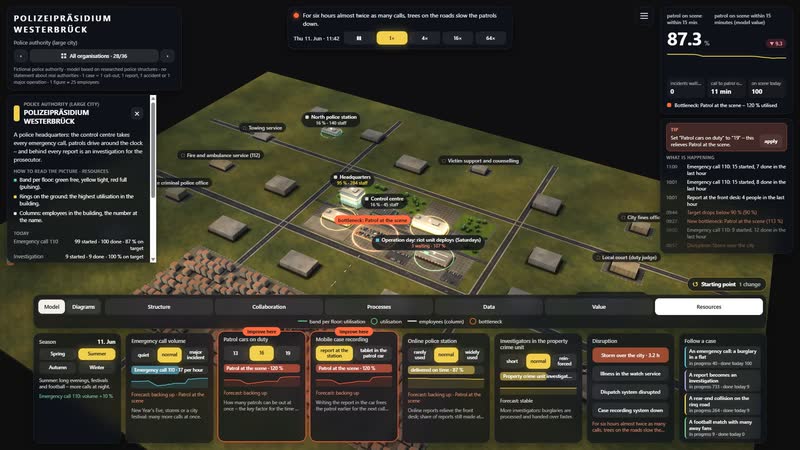
- Storm over the city: For six hours almost twice as many calls, trees on the roads slow the patrols down.
- Illness in the watch service: For three days a quarter of the patrols are missing.
- Dispatch system disrupted: Three hours with paper and radio: call taking and dispatch take three times as long.
- Case recording system down: For four hours no reports can be recorded.
What a police authority gets
-
01
The city as the operations area
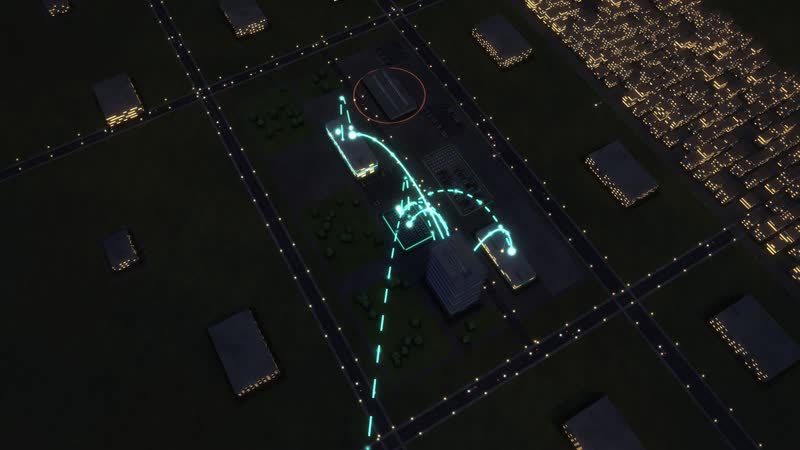
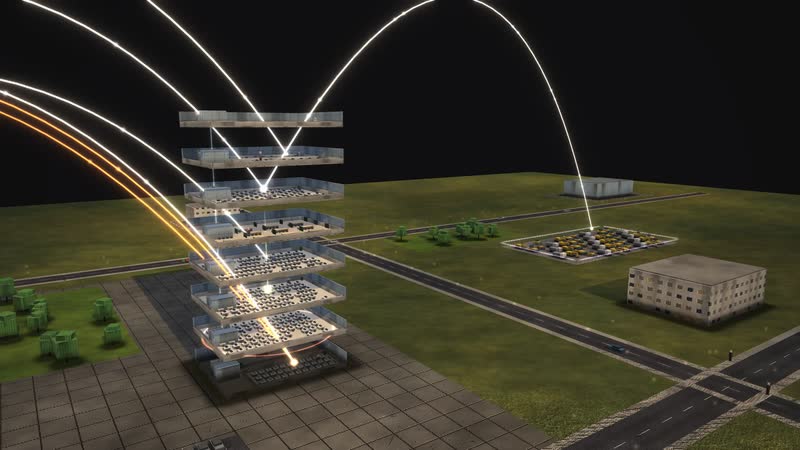
Headquarters, control centre, stations and criminal investigation are spread across the district. Points of light show every call-out on its way to the next unit.
-
02
Four kinds of operation at once
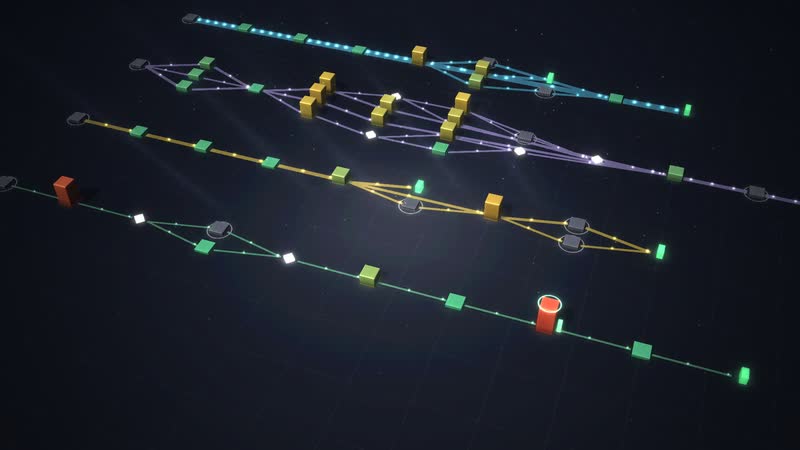
Emergency calls, crime reports, accidents and a major event run side by side in the event simulation. Bottlenecks in the control room or the patrol service show at once.
-
03
Play through the situation
Five controls and four disruptions, from a storm to a dispatch system failure. At a bottleneck a tip names the control that helps, and a button applies it.
-
04
Diagrams that calculate
14 diagrams in four groups are computed live from the model – from the path across the site to the headquarters' organisation chart.
-
05
For briefing room and lecture hall
Laptop or big screen: the model runs in the browser, and a guided tour in eight steps leads through the authority.
-
06
Not off the shelf
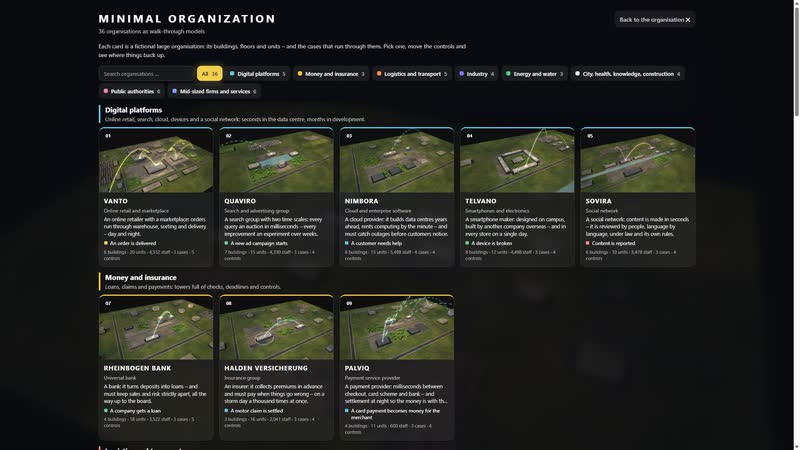
Designed by an artist and developer. An overview places the headquarters next to 35 other organisations, including a local court and a district administration.
-
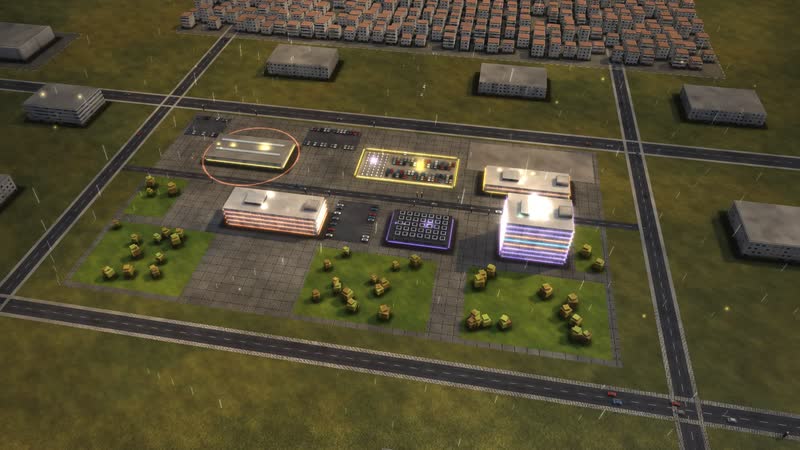
POLIZEIPRÄSIDIUM WESTERBRÜCK in the morning – low sun, long shadows, the first commuters on their way in. -
Headquarters in evening light – golden arcs show who reports to whom. -
Just before eight – people stream from the car park and the street into the buildings. -
Blue hour – the windows of POLIZEIPRÄSIDIUM WESTERBRÜCK light up. -
At night from above – Headquarters opened up, data lines glowing across the site. -
Headquarters opened up – every floor with workplaces and people. -
Dusk, performance view – rings of light show how busy each department is. -
Looking into the floor of Control centre – rows of desks, the floors above as outlines of light. -
A room of its own – Central police station. -
Criminal investigation department opened up – every floor with workplaces and people. -
Central police station – all floors at once, performance view. -
Structure at dusk – golden arcs from every floor to the buildings reporting to it. -
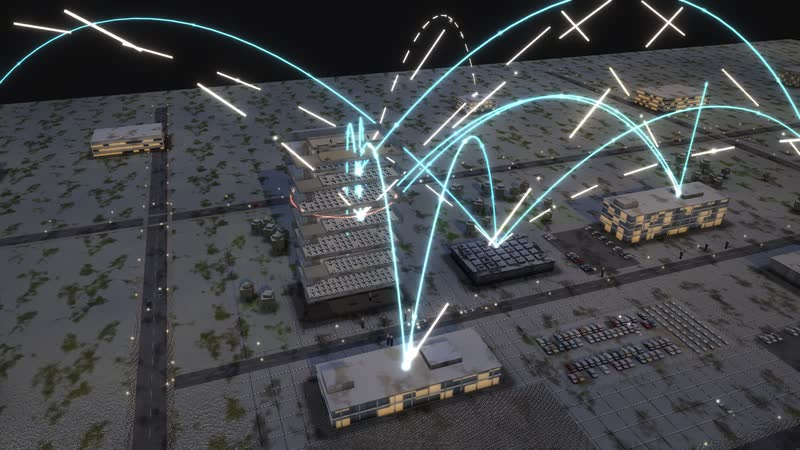
Collaboration – Control centre with all 6 relations – to departments, buildings and partners. -
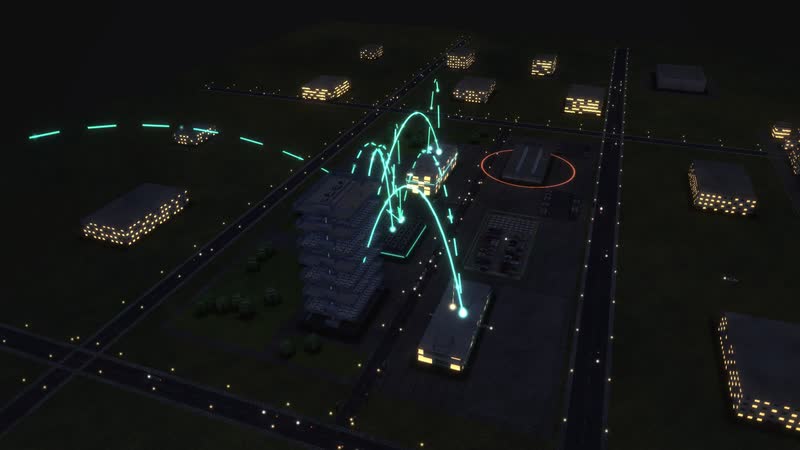
Data flows at night – systems and users linked by glowing lines. -
Data flows at dusk – which department uses which system. -
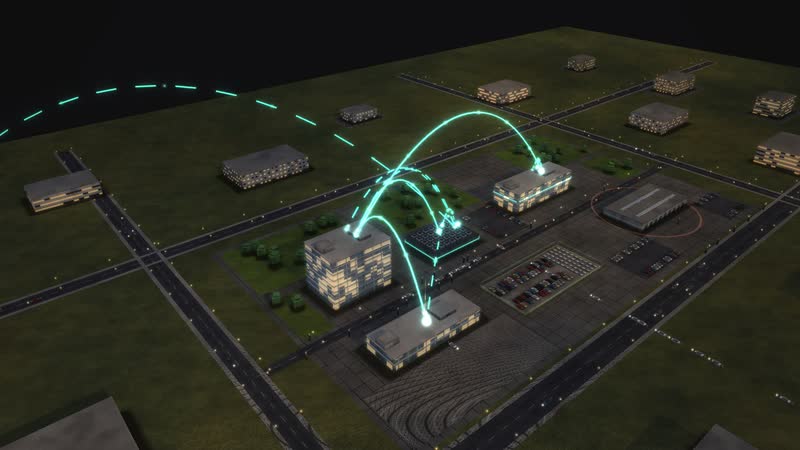
Structure across the whole site – reporting lines between the buildings. -
The whole network at night – collaboration inside and far beyond. -
Every step labelled – name, how many are waiting, utilisation. -
Following one case – ‘An emergency call: a burglary in a flat’ – step by step through the building. -
Storm over the city – resources view, the backlog grows floor by floor. -
Case recording system down – the data arcs turn red, work stalls. -
The lever – Patrol cars on duty set to ‘19’ – a flash shows where it acts. -
Spring at POLIZEIPRÄSIDIUM WESTERBRÜCK – Headquarters opened up, rings show the workload. -
Summer evening – warm light, long shadows, golden arcs above the square. -
Autumn – leaves on the paths, performance view. -
Winter evening – snow on the site, Headquarters open and lit, collaboration glowing. -
Diagram ‘Who works with whom’, calculated live from the model. -
Diagram ‘Year, week, day’, calculated live from the model. -
Diagram ‘Management levels as a staircase’, calculated live from the model. -
Diagram ‘How a case flows’, calculated live from the model. -
Diagram ‘What each control does’, calculated live from the model. -
Diagram ‘What the work depends on’, calculated live from the model. -
Diagram ‘Where it gets tight’, calculated live from the model. -
Diagram ‘Who leads whom’, calculated live from the model. -
The whole software – situation, key figure, time, views and the controls below. -
Headquarters selected – floor list on the right, the floors drift apart. -
Control centre – card with task, location and all relations. -
Storm over the city triggered – timeline, key figure and bottleneck react. -
Countering – Patrol cars on duty increased – the tile shows the effect since the change. -
Diagram ‘How a case flows’ with its panel – findings in sentences. -
Diagram ‘Who works with whom’ with its panel. -
Follow a case – step, waiting time and target on the card. -
The tour leads through the software in eight steps. -
36 organisations to choose from, each with its own picture.
Your police authority as a model
Would you like to see your headquarters with your own stations, call-outs and arrival times? Get in touch by email or phone and we will discuss how to get there. Access to the simulation: password on request.
cube4tec.de/spiele/minimal-organization/
Ask about this
Minimal Organization: Polizeibehörde
Basis and limits
Fictional police authority · model based on researched police structures · no statement about real authorities
1 case = 1 call-out, 1 report, 1 accident or 1 major operation · 1 figure ≈ 25 employees
All volumes, durations, rates and capacities are model assumptions, not values of a real police authority.
The 15-minute arrival target is a model value; there is no statutory response time for the police in Germany.
Only calls with a call-out are counted. In the model the patrol drives first and then waits for a free car; the total time is the same.
Documented: directorate structure of NRW police authorities, judicial review of custody, forwarding investigations to the prosecutor, special rights in traffic.
Public sources the model is based on:
- Organisation der Kreispolizeibehörden NRW (Ministerialblatt, recht.nrw.de)
- Polizeigesetz NRW (§§ 35–38)
- Grundgesetz Art. 104
- Strafprozessordnung (§§ 158, 160, 163)
- Straßenverkehrs-Ordnung (§§ 35, 38)
- Landtag NRW, Drucksache 16/434
- Landtag NRW, Drucksache 16/3947
- BKA: Polizeiliche Kriminalstatistik
- Polizei NRW: Internetwache
Similar business models
-
Local court
A local court as a walkable model: what happens between claim and judgment, where the months go and which levers shorten proceedings without touching judicial independence.
-
University hospital
A university hospital as a walkable model: see where an emergency patient's time goes and why the strongest lever sits on the wards.
-
District administration
A rural district administration as a walkable model: why the morning queue at vehicle registration grows, what shortens it and where the district office runs short of staff.
-
City administration
A large city's administration as a walkable model: see how a building application moves through the departments, how council and committees meet and where people queue at the counter.
-
Heating, plumbing and electrical contractor
A heating, plumbing and electrical contractor as a walkable model: what happens after a breakdown call, why the right part in the van matters and when the emergency service hits its limit.
-
Tax office
A tax office as a walkable model: how an income tax return travels from receipt to notice, where it waits and what speeds up processing.
-
Job centre
A job centre as a walkable model: how a benefit claim moves from reception to payment, where missing documents hold it up and how job placement runs alongside.
-
Health insurer
A statutory health insurer as a walkable model: how a wheelchair application moves from quote to decision, when the medical service steps in and where deadlines get tight.
All data are fictional, including call volumes and arrival times. The model can be adapted to your authority's real data and extended with information that is nowhere visible in one place today – for example calls per hour and district, or arrival times per station.